导航菜单
Innovation in food ingredients continues to drive growth in the global food industry. This article provides a comprehensive overview of China's new food ingredient landscape in 2025. Based on multi-dimensional data analysis, it aims to help global companies strategize for the Chinese food ingredient market in 2026.
As of December 31, 2025, China's National Health Commission (NHC) accepted 53 applications for new food ingredients, marking a record high in recent years. This growth reflects both supportive regulatory policies and sustained innovation efforts by industry players.
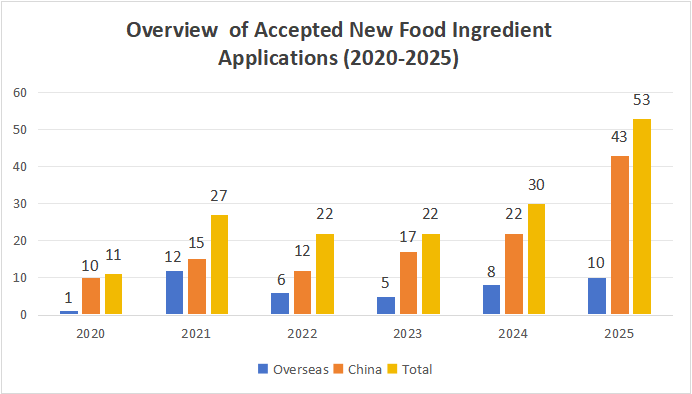
Of the 53 applications, 43 originated from China and 10 from overseas. China-origin ingredients continued to dominate and showed a notable year-on-year increase, while the number of overseas-origin ingredients remained largely stable.
1) Functional ingredients remained highly active
Examples include L-theanine, L-ergothioneine, β-lactoglobulin, N-acetylneuraminic acid (NANA), and N-acetylglucosamine (NAG). Notably, ergothioneine alone accounted for eight applications, about 15% of all submissions.
2) Microbial and probiotic ingredients continued to attract strong interest
These included Bifidobacterium longum subsp. infantis, Lactobacillus paracasei, Bacillus subtilis (natto), Bifidobacterium bifidum, Streptococcus salivarius, Pichia kluyveri, as well as the increasingly popular pasteurized Akkermansia muciniphila (AKK).
3) Plant-based ingredients and extracts also remained prominent
Representative examples include Cyclocarya paliurus extract, bilberry extract, vine tea polyphenols, and Pueraria lobata polysaccharides.
2 ingredients approved and 9 released for public consultation (based on declared names and historical acceptance records)
1 application rejected and 2 review opinion notices issued
The remaining applications are under extended technical review
In 2025, the NHC issued four "Three New Foods" announcements (No. 1, 3, 4, and 7), approving a total of 15 new food ingredients. Among them, rye pollen revised the content of Announcement No. 3 (2023), rendering the original provisions invalid.
A key regulatory milestone was the first-ever approval of D-allulose/D-psicose in China, signaling a significant breakthrough for synthetic biology-derived ingredients within China's regulatory framework.
Table 1: New Food Ingredients Approved in 2025
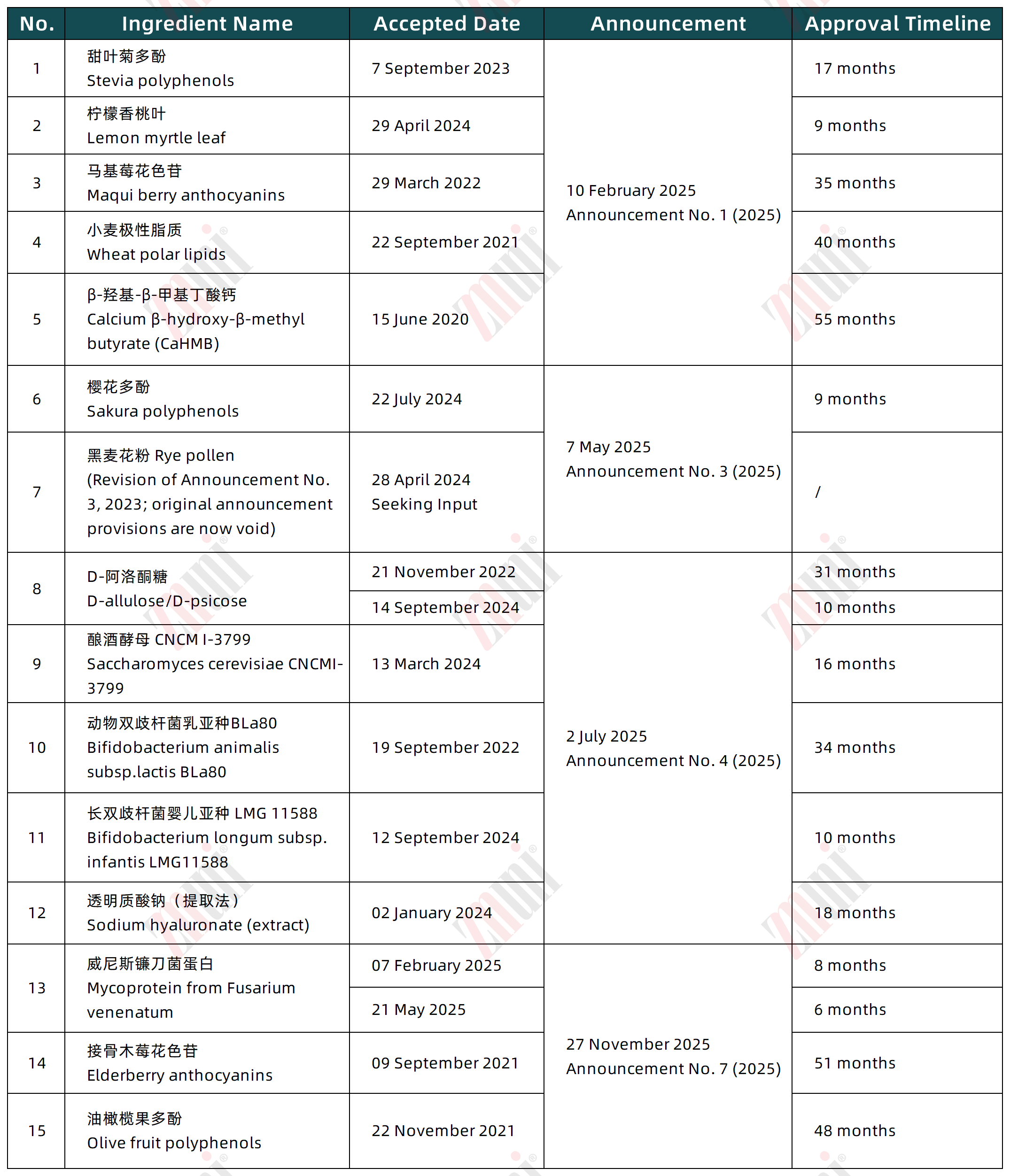
Earlier applications generally had longer review periods, with the longest reaching 55 months (e.g., calcium β-hydroxy-β-methylbutyrate). In contrast, ingredients submitted over the past one to two years were reviewed much faster, with the quickest approvals taking only 6-8 months (e.g., mycoprotein from Fusarium venenatum). This trend reflects improved regulatory efficiency driven by policy optimization, offering companies a more predictable development and commercialization timeline.
In addition to standard approvals, the NHC may recommend termination of review for ingredients deemed substantially equivalent to already approved ingredients in terms of composition and safety, or for those with a recognized history of long-term consumption. This pathway represents an alternative regulatory route with defined compliance requirements.
In 2025, the NHC updated 13 terminated-review cases on the public health administrative licensing platform:
11 ingredients were considered substantially equivalent to previously approved new food ingredients
2 ingredients (Lianghe Dian Zao Ying and Luohan Shen) were supported by documented consumption history
To date, the cumulative list of terminated-review ingredients has reached 95 entries.
In 2025, the China National Center for Food Safety Risk Assessment (CFSA) released five rounds of public consultation, covering 23 new food ingredients.
Table 2: New Food Ingredients Released for Public Consultation in 2025
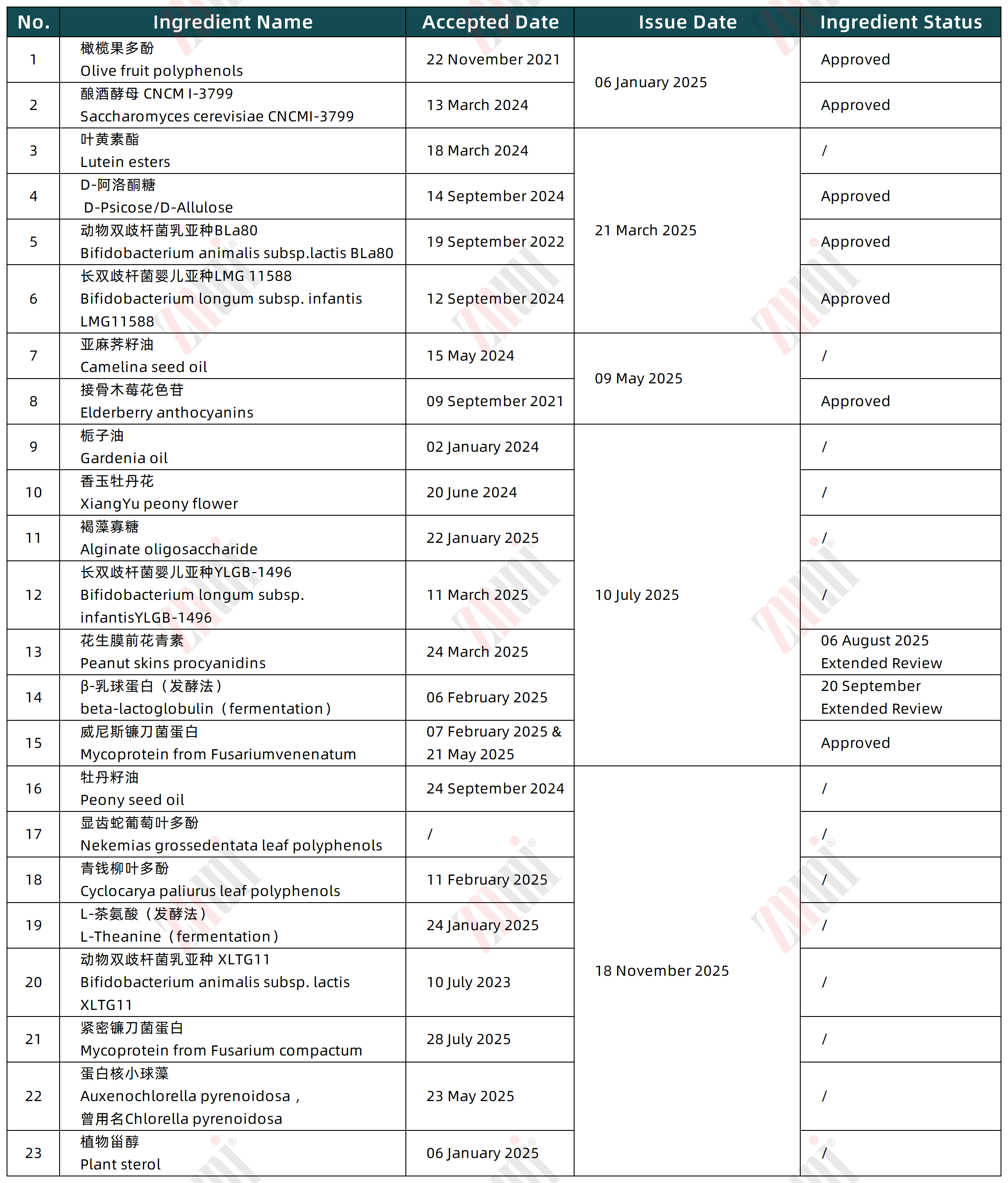
Among them, seven ingredients have since been formally approved, including:
Olive fruit polyphenols
Saccharomyces cerevisiae CNCM I-3799
D-allulose/D-psicose
Bifidobacterium animalis subsp. lactis BLa80
Bifidobacterium longum subsp. infantis LMG11588
Elderberry anthocyanins
Mycoprotein from Fusarium venenatum
The remaining 16 ingredients are still under review or subject to extended evaluation. If approved, they are expected to further strengthen industry confidence in R&D investment and regulatory submissions for similar ingredients.
The record-high number of new food ingredient applications in 2025 reflects not only growing innovation capacity across the industry, but also the continued maturation of China's regulatory system. Looking ahead, applications are expected to place greater emphasis on robust scientific evidence, process controllability, and comprehensive risk assessment, making regulatory compliance a core market entry threshold.
ZMUni Compliance Center has long specialized in market access services for innovative food ingredients. By closely tracking regulatory developments and review trends both in China and globally, we have built extensive hands-on experience in regulatory submissions.
We support companies throughout the entire compliance journey - from technical feasibility assessment and regulatory pathway design, to dossier preparation, authority communication, and risk evaluation—helping innovative ingredients enter the market efficiently and with confidence. For inquiries regarding new food ingredient applications in China or internationally, please contact us at info@zmumi.com.