导航菜单
On December 25, 2025, China's General Administration of Customs (GACC) released its list of non-compliant imported food products for November 2025. A total of 444 batches from 47 countries and regions were denied entry, representing a month-on-month increase of approximately 8.3% (up 34 batches from 410 in October) and a year-on-year decrease of about 12.4% (down 63 batches from 507 in November 2024).
Key Issues Identified:
Labeling issues remain the top concern, accounting for 19.8% of non-compliances, followed by sensory inspection failures and detection of unauthorized ingredients. In November, 88 batches were denied entry due to labeling problems, while the share of products containing unauthorized animal-derived ingredients or exceeding additive limits rose sharply from 0.2% last year to 4.3% and 3.2%, highlighting the need for stricter oversight.
About 11% of foods denied entry in November were due to formula compliance issues, excluding labeling issues. The main problems were excessive use of food additives, unapproved new food ingredients, and unauthorized animal-derived components. Affected products included instant noodles, ice cream, pastries, compound seasonings, and beverages.
|
Non-Compliance Issue |
Number of Batches |
|
Non-compliant labeling |
88 |
|
Unauthorized animal-derived ingredients |
19 |
|
Food additives not meeting national food safety standards |
12 |
|
Use of unapproved new food ingredients |
7 |
|
Sudan I and Sudan IV not meeting national food safety standards |
5 |
|
Excessive use of food additives |
2 |
|
aluminium potassium sulfate, aluminium ammonium sulfate not meeting national food safety standards |
1 |
Under the Food Safety Law of the People's Republic of China, imported foods, food additives, and related products must comply with China's national food safety standards. Given the significant differences in food safety regulations and standards across countries and regions, companies importing food into China must thoroughly verify the compliance of their product formulas, labels, and other relevant aspects before market entry. Ensuring full compliance with Chinese regulations is essential for smooth customs clearance and legal sale.
Food Safety Law of the People's Republic of China
GB 2760 – National Food Safety Standard: Standards for the Use of Food Additives
GB 14880 – National Food Safety Standard: Standards for the Use of Nutritional Fortifiers
GB 7718 – National Food Safety Standard: General Rules for Prepackaged Food Labeling
Announcements on Approval of New Food Ingredients
Import and Export Commodity Inspection Law of the People's Republic of China
Relevant national standards for food ingredients
Other relevant national standards for food products
Companies must strictly follow GB 2760 – National Food Safety Standard: Standards for the Use of Food Additives. This includes understanding which additives are permitted for different food categories, their allowed usage range, and maximum usage levels, in order to avoid compliance risks such as excessive or unauthorized use.
Foods produced with new food ingredients must obtain administrative approval from the health authority under the State Council, in accordance with the China's Food Safety Law. Companies should also ensure that product ingredient lists clearly indicate permitted intake, unsuitable populations, and other required information.
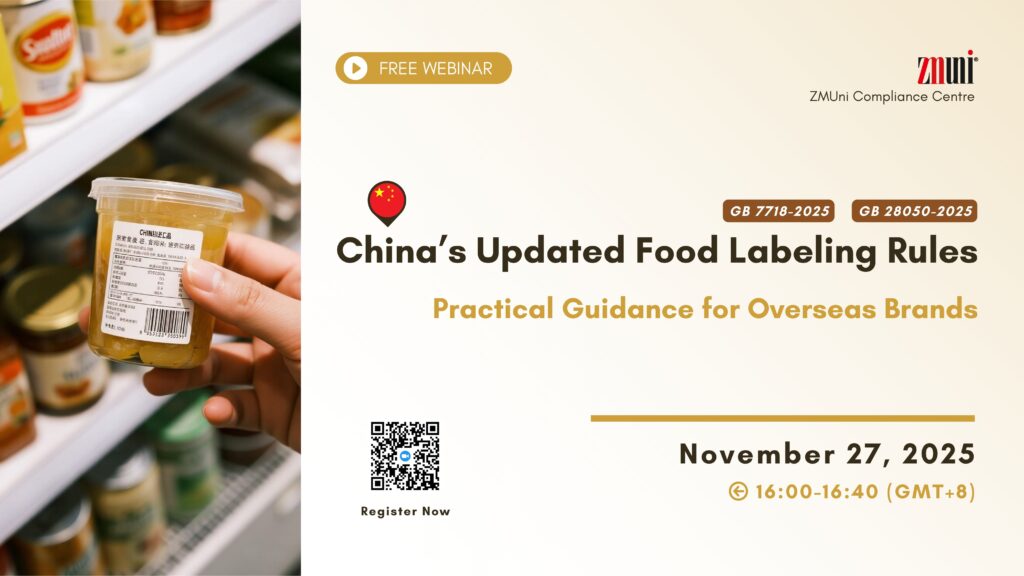
According to GB 7718 – National Food Safety Standard: General Rules for Prepackaged Food Labeling, all ingredients listed in foreign-language labels for imported prepackaged foods must have corresponding entries in Chinese labels. Ingredients not listed in foreign labels but required by Chinese laws and standards must also appear on the Chinese label.
Companies must avoid adding substances explicitly prohibited by Chinese regulations. Relevant guidance includes the Catalogue of Non-Edible Substances That May Be Added to Food, the State Administration for Market Regulations notices on illegal additives, and other documents outlining prohibited or potentially misused substances and additives.
ZMUni Compliance Centre reminds all industry stakeholders that food safety remains a top priority. Companies are encouraged to strengthen pre-import compliance checks, carefully verify customs documentation, and enhance supplier quality management to reduce the risk of import rejections.
Overseas food manufacturers and importers should stay up to date with the latest food laws and standards, and seek professional compliance guidance when needed to ensure smooth and timely market entry.
For more information on pre-packaged food compliance, including formula and label review services, please visit our food services under “China Pre-packaged Food Compliance,” or contact us at info@zmuni.com.
http://jckspj.customs.gov.cn/spj/2025-12/25/article_2025122816141441159.html