导航菜单

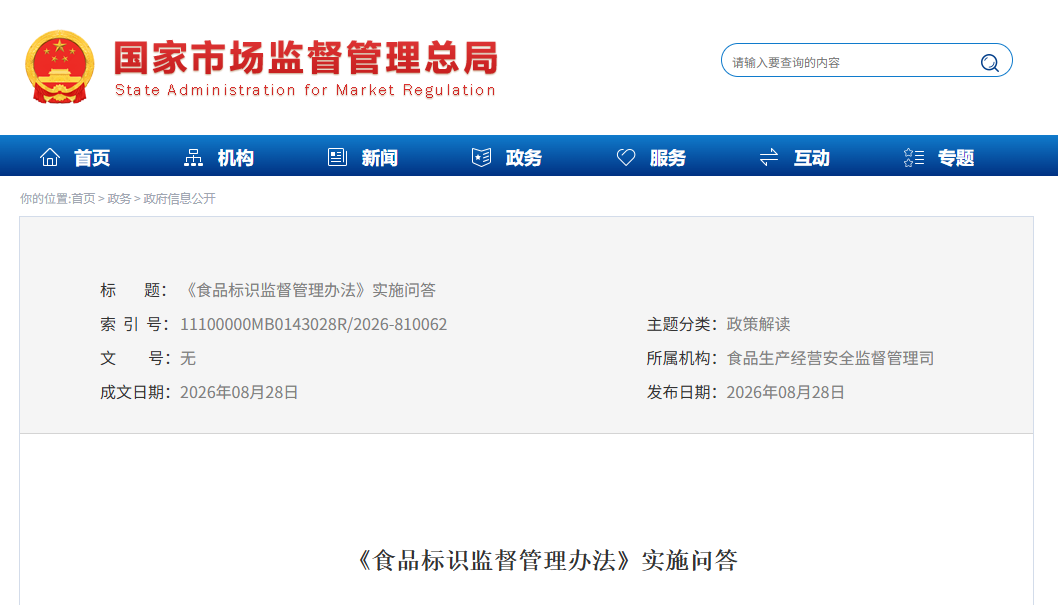
Recently, China's State Administration for Market Regulation (SAMR) released a Q&A document providing further interpretation of the Administrative Measures for the Supervision of Food Labeling. The document addresses 35 questions covering key aspects of food labeling supervision. In this article, ZMUni highlights some of the most commonly asked questions for your reference.
Answer: The Measures and GB 7718-2025 National Food Safety Standard General Standard for the Labeling of Prepackaged Food will both take effect at March 16, 2027. The two are complementary and focus on different aspects of food labeling.
As a mandatory food safety standard, GB 7718 primarily specifies the mandatory labeling information related to food safety, as well as the technical requirements for labeling prepackaged foods.
Building on food safety requirements, the Measures further regulate labeling practices for prepackaged foods, food additives, and unpackaged foods. They also strengthen regulatory oversight of food labeling and better protect consumers’ right to know and right to make informed choices.
Answer: The "separate area" refers to a designated area on the package specifically used to indicate the production date and expiry date. This area should not overlap with any other text, symbols, numbers, images, or other labeling information.
Food manufacturers are encouraged to use a clearly defined border with strong contrast against the background to mark the designated area for the production date and expiry date.
Answer: For transparent plastic bottles, glass bottles, and cans, production and expiry dates may be indicated using any of the following methods to ensure that consumers can read them clearly:
Laser engraving: Methods such as ultraviolet laser engraving may be used to create a clear color contrast between the date marking and the bottle cap, bottle bottom, or bottle body.
A designated area on the label: A separate area may be reserved during label design and printing, with the production and expiry dates printed in a clearly contrasting color during the labeling process.
Deep and enlarged laser engraving: Carbon dioxide laser engraving may be used to enlarge, bold, and deepen the date marking on transparent bottles or cans. In this case, clear and accurate wording should also be provided on the principal display panel to direct consumers to the location of the date marking. For example, for bottled drinking water, the principal display panel may state "Expiry date: see bottle shoulder," while the expiry date is marked on the bottle shoulder using numerals with a height of 3.3 mm.
Answer: The production date or expiry date may be preceded by terms such as "Production Date" or "Expiry Date."
Alternatively, the label may state "Production date and/or expiry date: see [specified location]" to direct consumers to where the relevant date information is provided.
Answer: For prepackaged foods with a single layer of packaging, the production date should be the date on which the packaging process is completed.
For prepackaged foods with multiple layers of packaging, the production date should be the date on which the packaging process that directly contacts the food (i.e., the inner packaging) is completed.
If sterilization, fermentation, or other processing steps are carried out after packaging is completed-whether after the single-layer packaging process or the inner packaging process for multilayer packaging-the date on which the relevant processing step is completed may be used as the production date.
Answer: Under the national standards for Pu'er tea (GB/T 22111) and dark tea (GB/T 32719), these products may be stored for extended periods under appropriate conditions.
For foods such as Pu'er tea and dark tea that can be stored for an extended period under appropriate storage conditions, the expiry date may be indicated as "ong-term storage."
Products labeled in this manner must remain safe and maintain stable quality under the storage conditions specified on the label, while continuing to comply with the applicable national food safety standards and relevant safety and quality requirements under the applicable product standards.
Answer: To prevent food names from misleading or deceiving consumers, the Measures emphasize that food names should reflect the food’s true nature and accurately indicate the ingredients used.
For foods made with animal-derived ingredients, if the product name identifies livestock or poultry meat or aquatic animal products, the named ingredient must be a major ingredient.
If only one type of animal-derived ingredient is identified in the product name, all of the relevant ingredient must come from that type of meat or aquatic animal product. If two or more types are identified, they must be listed in descending order based on the amount used.
For example, a meatball made with both beef and pork cannot be named "Beef Meatballs."
Answer: Where a single food production license covers multiple production addresses, the label may use any of the following methods:
Indicate only one of the actual production addresses listed on the food production license.
Indicate all addresses listed on the license and use a letter or number code on the package to identify the actual production address.
Use a combination of a physical label and a numerical label. For example, the physical label may indicate one of the addresses listed on the license that is convenient for consumers to use for contact purposes, while the other addresses are indicated using numerical labels. A letter or number code on the package can then be used to identify the actual production address.
Answer: Where a group company and its wholly owned subsidiaries jointly produce a food by undertaking different stages of the production process, and the group company assumes overall responsibility for the product's quality and safety, the group company may be identified as the manufacturer on the label.
The subsidiary responsible for a particular stage of production may additionally be identified as a co-manufacturer using a numerical label.
Answer: The warning statement area and warning statement on health food labels should generally comply with the requirements of the Guidelines for Labeling Warning Statements on Health Foods.
However, for health foods whose largest surface area of the smallest sales unit is less than 35 cm2, the warning statement area is not required to occupy at least 20% of the relevant panel as specified in the Guidelines.
Other requirements for the warning statement, including font, color contrast, and font height, should still comply with the Guidelines for Labeling Warning Statements on Health Foods.
Answer: To better protect consumers'right to know, safeguard the food safety of individuals with allergies, and improve product information transparency, health foods containing allergenic ingredients should proactively and fully indicate relevant allergen information.
Such labeling should comply with the Guidelines for Health Food Registration and Notification (Trial) and applicable national food safety standards, enabling consumers to clearly identify potential risks and make informed purchasing decisions.
Answer: Foods produced on or after the effective date of the Food Safety National Standard - General Standard for the Labeling of Prepackaged Foods (GB 7718-2025), the Food Safety National Standard - General Standard for Nutrition Labeling of Prepackaged Foods (GB 28050-2025), and the Administrative Measures for the Supervision of Food Labeling must comply with the requirements of these standards and regulations.
Foods produced before the effective date may continue to be sold until their expiry date, provided that their labeling does not violate any prohibited provisions under these standards and regulations.
However, if the labeling violates a prohibited requirement, the product may no longer be sold. For example, a food product labeled with a “Zero Additive” claim may not continue to be sold after the Measures take effect.
For the full list of 35 questions and answers, please refer to the official Q&A published by China SAMR.
Official Link:
https://www.samr.gov.cn/zw/zfxxgk/fdzdgknr/spscs/art/2026/art_9a2980ad60f7459aab4d6f5b9902767b.html