导航菜单

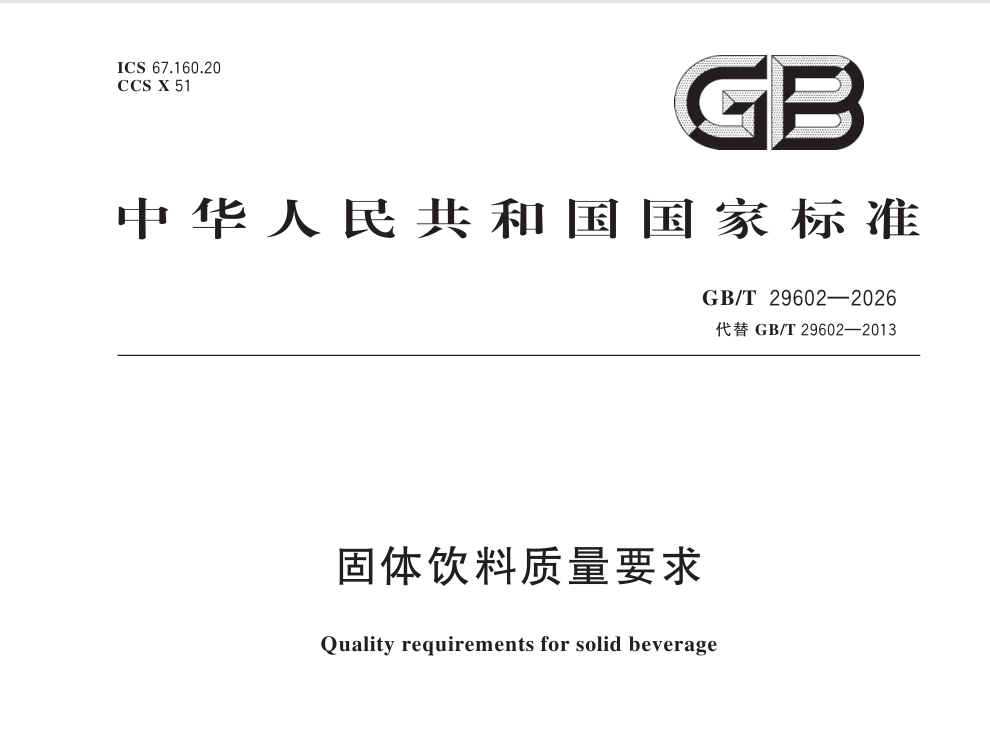
On July 2, 2026, the State Administration for Market Regulation (SAMR) and the Standardization Administration of China (SAC) approved 508 recommended national standards and one amendment. Among them is GB/T 29602-2026 Quality Requirements for Solid Beverages (hereinafter referred to as GB/T 29602-2026).
Developed under the leadership of the China Beverage Industry Association, GB/T 29602-2026 will take effect on August 1, 2027, replacing GB/T 29602-2013.
China's solid beverage market has expanded rapidly in recent years, alongside growing concerns over unclear product definitions, blurred category boundaries, and misleading labeling and claims. GB/T 29602-2026 strengthens requirements for terminology, product classification, and labeling to provide clearer guidance for compliant production.
Key revisions include:
Updated terminology and definitions
Adjustments to product classification
New requirements for food ingredients and auxiliary materials
Revised physicochemical and testing requirements
Removal of food safety requirements
Significant updates to labeling and packaging
Adjustments to sampling and factory inspection requirements
Labeling is one of the most significantly revised areas under GB/T 29602-2026. The new standard introduces clearer requirements on product names, category identification, warning statements, claims, and category-specific labeling.
GB/T 29602-2026 establishes clearer boundaries to prevent solid beverages from being confused with special foods or pharmaceutical products. Under GB/T 29602-2026, product names must not:
Be identical to the names of officially approved special foods;
Use terms such as "granules" or other expressions that may cause confusion with pharmaceutical products.
The term "solid beverage" must be prominently displayed to accurately reflect the product's food category. Its font size must not be smaller than that of any other text appearing on the same display panel, including text contained in trademarks or graphics.
Certain solid beverages sold directly to consumers must carry a warning statement. This applies to:
Protein solid beverages
Plant-based solid beverages
Nutrient solid beverages
Electrolyte solid beverages
Sports solid beverages
Flavored solid beverages
Solid beverages containing live lactic acid bacteria
The following warning statement must be displayed:
"This product cannot replace special foods such as foods for special medical purposes, infant formula foods, or health foods."
The warning statement must appear on the same display panel of the smallest sales unit and occupy at least 20% of the area of that panel.
GB/T 29602-2026 sets clear boundaries for product labeling, instructions, and promotional materials. Solid beverages must not:
Be presented in a way that may cause confusion with dairy products, health foods, FSMPs, infant formula foods, or other foods for special dietary uses;
Explicitly or implicitly suggest suitability for specific groups, such as minors, older adults, pregnant or lactating women, patients, or individuals at nutritional risk;
Suggest disease prevention, disease treatment, health benefits, or suitability for people with specific diseases through manufacturing processes or ingredient names;
Claim corresponding health functions simply because the product contains ingredients listed in the catalogue of raw materials for health foods;
Use the terms "meal replacement" or "nutrition powder" on the product label.
The new standard also introduces more detailed labeling requirements for specific product categories:
| Product Category | Key Labeling Requirement |
|---|---|
|
Fruit and/or vegetable juice solid beverages |
Indicate the fruit and/or vegetable juice content after preparation. Compound products must also disclose the mixing ratio of different juices. |
|
Protein solid beverages |
Indicate protein content. Compound protein products must disclose the protein contribution ratio from different sources. |
|
Milk protein solid beverages |
Certain names that may cause confusion with other food categories, such as "whey protein powder" or "milk powder," are prohibited. |
|
Tea-based solid beverages |
Products named after a specific tea ingredient must meet specified ingredient proportion requirements. |
|
Fruit tea solid beverages |
Indicate fruit juice content after preparation. |
|
Coffee-based solid beverages |
Indicate caffeine content after preparation. Claims relating to a specific coffee variety or origin are subject to minimum usage thresholds. |
|
Solid beverages containing live lactic acid bacteria |
Indicate the viable count of lactic acid bacteria. |
GB/T 29602-2026 recommends displaying recycling marks on product labels and/or packaging with reference to GB/T 18455 Packaging Recycling Marks, reflecting the increasing focus on sustainable packaging and recyclability.
ZMUni Reminder
GB/T 29602-2026 will take effect on August 1, 2027, giving manufacturers and importers approximately one year to prepare. Businesses should review the new requirements and assess their impact on product specifications, labeling, marketing claims, and packaging.
ZMUni Compliance Centre provides prepackaged food compliance and market access support. Contact us to learn how we can help your products achieve compliant market entry into China and other relevant markets.