

+86 571 8659 2517

+86 180 5841 8258

info@zmuni.com


On December 26, 2025, China's National Medical Products Administration (NMPA) released the draft revision of the Provisions for Management of New Cosmetic Ingredient Registration and Notification Dossiers for public consultation. The consultation period runs from December 26, 2025, to January 25, 2026, and feedback can be submitted via email to hzpjgyc@nmpa.gov.cn. The Provisions for Management of New Cosmetic Ingredient Registration and Notification Dossiers, in effect since May 1, 2021, provide key guidance for the registration and notification of new cosmetic ingredients in China. Before their implementation, approved new ingredients were very limited, and some internationally widely used ingredients could
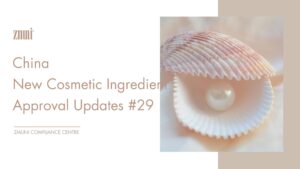
From December 17 to 23, 2025, 4 new cosmetic ingredients (NCIs) have completed notifications with China’s National Medical Products Administration (NMPA). The technical requirements for the 4 new cosmetic ingredients mentioned above have not been disclosed, and they have not yet entered the safety monitoring period. Notification No. 20250161 In March 2024, OSM filed a patent (CN 117625405 A) covering a novel Antarctic-derived Aureobasidium pullulans strain designed for pearl co-fermentation. The resulting fermentation products show enhanced UV protection, collagen promotion, skin repair, and skin barrier–strengthening effects. Deqing OSM established in 2003, is a subsidiary of OSM Biotech Co., Ltd. Founded in 1967, OSM Biotech

On December 19, 2025, China's National Institutes for Food and Drug Control (NIFDC) released Technical Guidelines for Cosmetic Ingredient Intended Uses(Trial), the Guidelines will come into effect on June 19, 2026. The NIFDC also provided responses to several key questions regarding the Guidelines: What is meant by "cosmetic ingredient intended uses"? The "intended uses" of a cosmetic ingredient refers to the intended function of the ingredient when added to a cosmetic product. This includes effects exerted at the site of application (e.g., hair dyes), as well as functions within the formulation system itself (e.g., solvents). Depending on how an

On December 16, 2025, China's National Institutes for Food and Drug Control (NIFDC) released two cosmetic technical guidance documents, including the Technical Guidelines for Anti-Hair Loss Products (Trial) and Technical Guidelines for Research on Efficacy-Related Ingredients in Anti-Hair Loss Cosmetics (Trial), together with the corresponding Q&A. The draft versions of these documents were previously released for public consultation in September 2025. Key Highlights from the Q&A: Q1: What ingredients are considered efficacy-related ingredients for anti-hair loss cosmetics? A: Efficacy-related ingredients for anti-hair loss cosmetics are divided into two categories: Anti-hair loss agents, which are single ingredients or components within ingredients
From December 10 to 16, 2025, 6 new cosmetic ingredients (NCIs) have completed notifications with China’s National Medical Products Administration (NMPA). The technical requirements for the 6 new cosmetic ingredients mentioned above have not been disclosed, and they have not yet entered the safety monitoring period. Notably, three of the six NCIs were notified by overseas companies from Italy, South Korea, and Thailand. C18-22 Hydroxyalkyl Hydroxypropyl Guar According to Lamberti's official website, C18-22 Hydroxyalkyl Hydroxypropyl Guar, marketed as ESAFLOR® HM 22, is a hydrophobically modified bio-based ingredient with notable emulsifying properties and sensory characteristics. It can be used with other emulsifiers to create a variety

On December 15, 2025, China's National Institutes for Food and Drug Control (NIFDC) released the Technical Guidelines for Updating New Cosmetic Ingredient Notification Information. The document was initially opened for public consultation in March 2025. Alongside the guidelines, NIFDC also published a set of Q&A to clarify key points and assist industry stakeholders in implementing the updated notification requirements. Key Highlights from the Q&A: Scope The guidelines apply to updating information for new cosmetic ingredients before they are included in the Catalogue of Used Cosmetic Ingredients. Updates should generally not occur within one month of the

On December 11, 2025, China's National Institutes for Food and Drug Control (NIFDC) released two draft technical guidance documents on the naming of new cosmetic ingredients for public consultation, namely the Technical Guidelines for the Naming of Plant-Derived New Cosmetic Ingredients (Draft for Comments) and the Technical Guidelines for the Naming of Fermentation-Derived New Cosmetic Ingredients (Draft for Comments). The public consultation period is open until December 26. Detailed information are as follows: Technical Guidelines for the Naming of Plant-Derived New Cosmetic Ingredients (Draft for Comments) It applies to the study and determination of Chinese names for new cosmetic ingredients derived from plants, as well as new

On December 12, 2025, China National Medical Products Administration (NMPA) issued a three-year action plan (2026–2028) to enhance the quality management systems of cosmetics enterprises. The initiative aims to improve product safety, boost industry competitiveness, and promote high-quality development in China's cosmetics sector. The plan focuses on several key areas: Enhancing Corporate Quality Systems Emphasizes enterprise responsibility and accountability of key personnel. Strengthens oversight of registration and filing processes and ensures production consistency controls are effectively implemented. Strengthening Risk Control and Compliance Promotes comprehensive product lifecycle management. Encourages batch release procedures, self-inspections, and corrective actions to
+86 571 8659 2517
+86 180 5841 8258
info@zmuni.com