导航菜单

Cosmetic claims play an important role in product marketing and regulatory compliance worldwide. While requirements vary across markets, China has a distinct approach to regulating cosmetic efficacy claims. For example, beyond requiring appropriate supporting evidence, China links claimed efficacy to product classification and registration or filing requirements.
For overseas brands entering China, understanding this framework is an important step in assessing regulatory obligations. This article explores China’s cosmetic efficacy classification system, key substantiation requirements, and recent developments concerning cosmetics claiming new efficacy.
Under China's Cosmetic Classification Rules and Catalogue, efficacy claims are classified into 21 categories for general cosmetics, five categories for special cosmetics, and a separate category for new efficacy.
This framework can be summarized conceptually as "21 + 5 + new efficacy". However, new efficacy is not a separate regulatory pathway parallel to general and special cosmetics. Cosmetics claiming new efficacy are subject to special cosmetics registration.
| No. | Efficacy |
Interpretation |
|---|---|---|
| A |
New Efficacy |
A cosmetic may be classified as claiming new efficacy if its efficacy claim, application site or target population falls outside the applicable categories in China's classification rules. |
| 1 |
Hair Dyeing |
For the purpose of changing hair color; the original hair color cannot be restored after immediate washing |
| 2 |
Hair Perming |
For changing hair curl (curling or straightening) and maintaining relative stability |
| 3 |
Whitening & Freckle-Reducing |
Helps reduce or slow down skin pigmentation to achieve skin whitening effect; achieves skin whitening effect through physical coverage |
| 4 |
Sun Protection |
For protecting skin and lips from damage caused by specific ultraviolet rays |
| 5 |
Anti-Hair Loss |
Helps reduce hair loss |
| 6 |
Anti-Acne |
Helps reduce or slow down acne occurrence (including blackheads or whiteheads); helps skin recovery after acne breakouts |
| 7 |
Nourishing |
Helps provide nourishment to the application area |
| 8 |
Repairing |
Helps maintain the normal state of the application area |
| 9 |
Cleansing |
For removing dirt and attachments from the surface of the application area |
| 10 |
Makeup Removing |
For removing makeup and other cosmetics from the application area |
| 11 |
Moisturizing |
For supplementing or enhancing the content of moisture, oil and other components in the application area; helps maintain the moisture content of the application area or reduce moisture loss |
| 12 |
Beauty & Decoration |
For temporarily changing the appearance of the application area to achieve beautification and decoration effects; the original state can be restored after cleansing and makeup removal |
| 13 |
Fragrancing |
Contains aromatic ingredients, helps modify body odor and add fragrance |
| 14 |
Deodorizing |
Helps reduce or cover body odor |
| 15 |
Anti-Wrinkle |
Helps slow down the formation of skin wrinkles or make wrinkles less noticeable |
| 16 |
Firming |
Helps maintain skin firmness and elasticity |
| 17 |
Soothing |
Helps improve skin irritation and other conditions |
| 18 |
Oil Control |
Helps slow down the secretion and deposition of sebum in the application area, or makes the oiliness of the application area less noticeable |
| 19 |
Exfoliating |
Helps promote the shedding or renewal of skin cuticles |
| 20 |
Refreshing |
Helps keep the skin dry or enhance the coolness of the skin |
| 21 |
Hair Care |
Helps improve the combability of hair and beard, prevent static electricity, and maintain or enhance hair luster |
| 22 |
Anti-Hair Breakage |
Helps improve or reduce hair breakage and split ends; helps maintain or enhance hair toughness |
| 23 |
Anti-Dandruff |
Helps slow down the production of dandruff; helps reduce dandruff attached to the scalp and hair |
| 24 |
Hair Color Maintenance |
Helps maintain the stability of hair color before and after hair coloring |
| 25 |
Hair Removal |
For reducing or removing body hair |
| 26 |
Shaving Assistance |
For softening and swelling facial hair, helping to lubricate the skin during shaving |
What Is a Cosmetic Claiming New Efficacy?
A cosmetic claiming new efficacy makes a claim that falls outside the 26 existing categories. Potential examples include certain claims relating to maternal care, blue-light protection, antioxidant effects, anti-glycation, anti-aging or skin tanning, depending on the precise claim and its scope. Whether a claim qualifies as new efficacy must be assessed against the existing catalogue and category definitions.
Claims must be consistent with the product's registration or filing information. General cosmetics cannot claim special cosmetic efficacy without the required registration.
Cosmetics must not claim medical effects. Examples include "treats acne," "repairs hormone-damaged skin," and "anti-inflammatory treatment." Terms such as "medical-grade cosmetics" and unsupported absolute claims like "permanent wrinkle removal" also require particular scrutiny.
Special cosmetics: Claims such as whitening and freckle removal, sunscreen and anti-hair loss require special cosmetic registration and applicable human efficacy evaluation.
General cosmetics: Claims such as moisturizing, anti-wrinkle, firming, soothing and oil control must be supported by appropriate scientific evidence, such as human efficacy tests, consumer-use tests, laboratory tests or literature.
Claims identifiable through sensory perception: Certain claims, such as cleansing, makeup removal and fragrance, may be exempt from publishing efficacy claim summaries. Certain physical effects, such as whitening through physical coverage, may also qualify for exemptions from efficacy evaluation documentation, subject to applicable requirements.
Non-compliant claims may lead to administrative penalties, corrective orders, fines and, in serious cases, licence revocation or civil liability.
On October 20, 2026, China's National Institutes for Drug Control (NIDC) published a trial mechanism for pre-submission consultation on cosmetics claiming new efficacy.
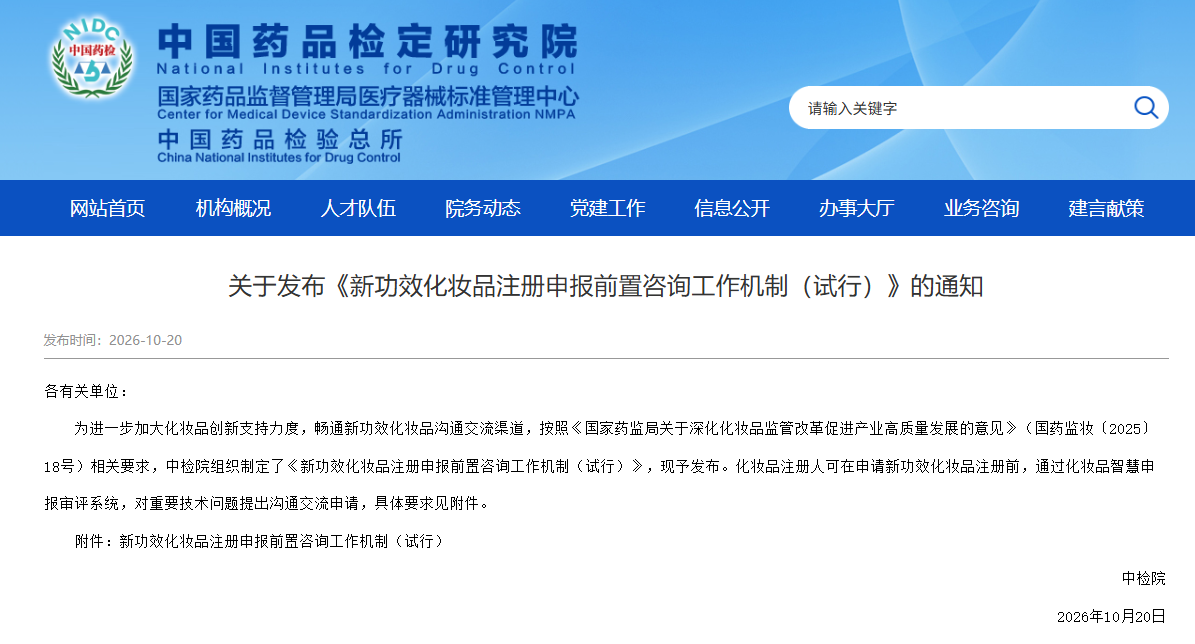
The mechanism allows applicants to discuss technical questions with the relevant review department before submitting a registration application. Topics may include whether a proposed efficacy claim falls within the scope of new efficacy, application procedures, and technical questions concerning the product's mechanism of action and efficacy and safety evaluation.
For brands developing innovative cosmetic claims, this mechanism offers an opportunity to clarify technical questions at an early stage before proceeding with registration. The consultation provides guidance only and does not guarantee a successful registration outcome. Applicable registration requirements remain in force.
ZMUni supports new efficacy projects throughout their lifecycle, from initial assessment to post-market compliance.
Support project proposals and industry–academia–research collaboration
Coordinate R&D and marketing requirements
Assess efficacy classification and regulatory compliance
Design efficacy and safety evaluation plans and coordinate implementation
Plan project timelines and costs
Prepare registration dossiers and provide technical support
Manage submissions and communicate with review authorities
Review efficacy claims and help manage compliance risks
Support ongoing compliance with applicable regulations
Contact ZMUni at info@zmuni.com to discuss your cosmetic compliance needs in China.