导航菜单
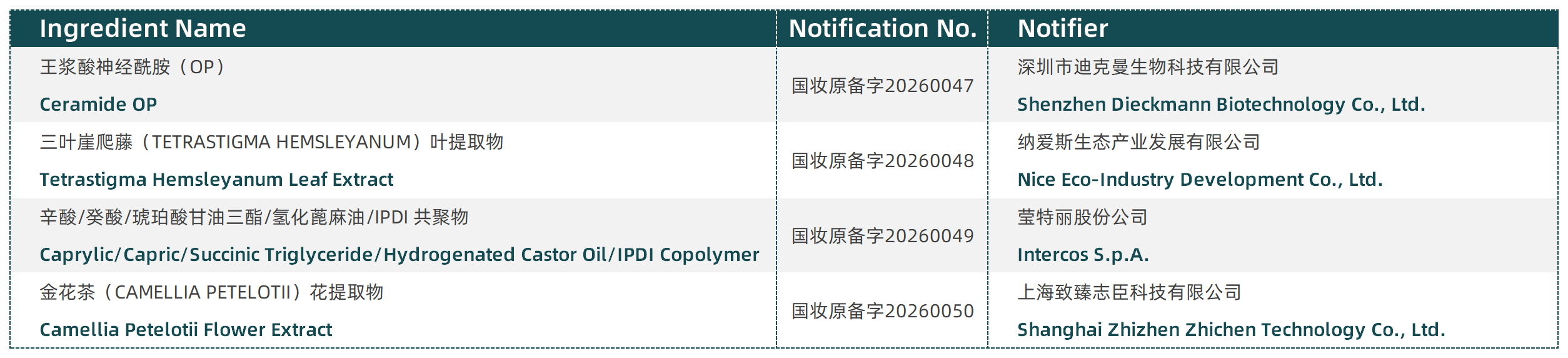
From March 16 to March 23, 2026, 4 new cosmetic ingredients (NCIs) have completed notifications with China’s National Medical Products Administration (NMPA).
Royal jelly, often referred to as a "longevity factor," is rich in 10-hydroxy-2-decenoic acid (10-HDA), a key active known for its strong antioxidant and anti-aging potential. However, single-ingredient approaches face limitations in addressing photoaging and repair.
An upgraded derivative, Ceramide OP, demonstrates enhanced performance compared with 10-HDA. It shows superior efficacy in promoting skin tissue repair, improving elasticity and resilience, and combating skin aging.
Tetrastigma hemsleyanum is a vine species commonly found in the hilly and mountainous regions of Lishui, Zhejiang. Traditionally used in She ethnic medicine, its leaves and stems are applied topically for wound care. The ancient herbal text Chuzhou Bencao records its functions in "cooling the blood, detoxifying, and reducing swelling and lumps."
The NICE R&D team has conducted years of resource surveys and efficacy studies in Lishui. Focusing on the abundant local leaf resources of this plant, the team has successfully overcome key technical challenges, including active compound enrichment and pesticide residue control. Through scientific validation, the ingredient has demonstrated notable benefits in moisturizing, soothing, and anti-inflammatory applications, marking another significant milestone in the company’s development of local botanical resources.
This ingredient is a multifunctional oil-phase film former designed to enhance long-lasting wear, water resistance, and transfer resistance while delivering a smooth, flexible skin feel, commonly used in sunscreens, foundations, BB creams, and color cosmetics such as lip and eye products.
Intercos S.p.A., a Milan-based global cosmetics manufacturer founded in 1972, focuses on color cosmetics, cosmetic pencils, nail products, and skincare. Since 2021, the company has completed the notifications of 10 new cosmetic ingredients in China.
Camellia petelotii, commonly known as Golden Camellia, is a Camellia species native to southern Guangxi, China. In December 2024, it was approved by China’s National Health Commission as a new food ingredient, with the leaves designated as the edible part.
In the cosmetics sector, Golden Camellia–derived ingredients have shown steady regulatory progress. With the latest notification, a total of seven extracts from the flowers and leaves of Camellia chrysantha and Camellia petelotii have been notified as New Cosmetic Ingredients in China since 2021.
Issue 36: New Natural and Bioactive Ingredients
Issue 35: Ongoing Notifications by Major Chinese Players
Issue 34: Five Ingredients, Five Technical Paths
......