导航菜单

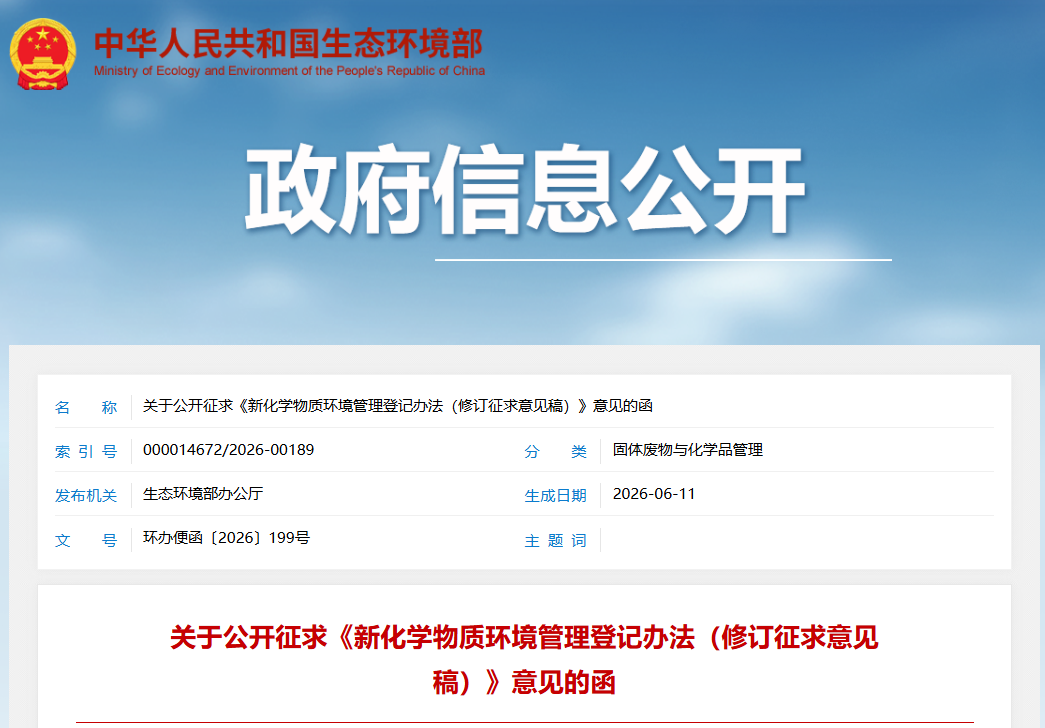
On June 11, 2026, the Ministry of Ecology and Environment of the People's Republic of China (MEE) issued a draft revision of the Measures for the Environmental Management Registration of New Chemical Substances (commonly known as "China REACH").
The revision proposes significant changes to the current MEE Order No. 12 of 2020 and is expected to take effect on August 15, 2026, together with the Ecological and Environmental Code of the People's Republic of China.
For cosmetic companies and raw material suppliers, this update represents a significant shift in China's chemical management framework. Cosmetics, which were previously outside the scope of new chemical substance registration requirements, may now face additional environmental compliance obligations.
This article highlights the key changes, potential impacts, and recommended actions for industry stakeholders.
Current Regulation: Cosmetics Excluded from Scope
(effective until August 14, 2026)
Under the current MEE Order No.12, products including cosmetics, pharmaceuticals, pesticides, food, and other regulated categories are excluded from new chemical substance registration requirements, as they are considered to be managed under separate regulatory systems.
As a result, cosmetic ingredients have historically been subject mainly to safety and product compliance requirements, while environmental registration obligations generally did not apply.
Proposed Revision:Cosmetics Included in Regulatory Scope
(effective from August 15, 2026)
The draft revision removes cosmetics and several other product categories from the exemption list, including:
Cosmetics;
Pharmaceuticals and active pharmaceutical ingredients;
Pesticides and pesticide active ingredients;
Veterinary drugs;
Food and food additives;
Feed and feed additives;
Fertilizers.
Meanwhile, certain substances remain exempt, including chemical substances used exclusively for scientific research, testing, measurement, monitoring, and other technical service activities.
Implications for Cosmetic Companies
If a cosmetic ingredient is a chemical substance not listed in the Inventory of Existing Chemical Substances in China (IECSC) and does not qualify for an applicable exemption, China REACH registration may be required before the ingredient can be used in cosmetic products in China.
The draft revision clarifies that registration responsibility will depend on the entity introducing or manufacturing the new chemical substance in China.
For imported cosmetics containing new chemical substances, the Chinese importer will generally be responsible for registration.
For domestically developed ingredients, responsibility will fall on the entity that develops and manufactures the substance, either the cosmetic company or raw material supplier.
1. Registration Responsibility Will Shift to Chinese Entities
Under the current MEE Order No.12, overseas companies may apply for new chemical substance registration through a China-based agent, such as an importer, affiliated company, or qualified third-party entity. The registration certificate is issued under the name of the overseas applicant.
Under the proposed revision, the agent system will be abolished. Overseas companies must have a qualified Chinese entity (e.g., a domestic importer or China-based affiliate) act as the applicant. The registration certificate will be issued under the name of the Chinese applicant.
For overseas ingredient suppliers, this means that existing registration arrangements may need to be reviewed and restructured. Suppliers should proactively discuss with Chinese partners regarding registration responsibilities, data authorization, ownership of registration rights, and cost allocation.
2. More New Ingredients May Require Formal Registration Before Market Entry
The proposed revision significantly changes the current registration categories.
|
MEE Order No.12 |
Proposed Revision |
|
|
For overseas suppliers, cosmetic ingredients that previously relied on low-volume filing for faster market entry may face longer approval timelines before commercialization in China.
3. Some Ingredients May Remain Under New Chemical Substance Management Long Term
Under the current system, substances that complete regular registration are generally included in the IECSC after five years.
However, under the proposed revision, certain substances may not be included in the IECSC, including substances subject to new use management, polymers exempt from IECSC inclusion, and substances with nationwide cumulative production or import volumes below the applicable threshold (<10 tons).
As a result, some new cosmetic ingredients may remain regulated as new chemical substances for an extended period. Future importers or manufacturers may need to complete separate registration procedures, which could affect long-term supply arrangements and market expansion strategies.
4. Existing Filed Substances Will Need to Complete Registration Conversion
Existing filed substances under MEE Order No.12 will need to obtain new chemical substance registration certificates by December 31, 2026.
For overseas suppliers that have previously introduced cosmetic ingredients into China through the filing procedure, it is important to review existing filings and confirm transition arrangements with Chinese registration partners. Failure to complete the required conversion within the specified timeframe may affect the continued supply and use of these ingredients in the Chinese market.
1. Identify Ingredients That May Require Registration
Overseas suppliers should review cosmetic ingredients currently supplied to the Chinese market to identify substances that may fall under the revised requirements, particularly those not listed in the Inventory of Existing Chemical Substances in China (IECSC).
The assessment should consider the substance’s existing filing/registration status under MEE Order No.12, annual production/import volume, and relevant characteristics (e.g., polymer status) to determine whether China REACH registration may be required.
For newly developed ingredients, suppliers should assess potential registration obligations at an early stage and prepare necessary technical data where applicable.
2. Confirm Registration Responsibilities with Chinese Partners
Under the proposed revision, overseas companies may no longer be able to directly apply for new chemical substance registration. Suppliers should proactively communicate with Chinese importers, distributors, or affiliated companies to determine the appropriate registration arrangement.
Key considerations include:
Identifying the entity responsible for registration in China;
Establishing agreements on data authorization, registration cost sharing, and confidential business information (CBI) protection;
Clarifying compliance responsibilities across the supply chain.
Early alignment with Chinese partners will help overseas suppliers maintain market access and avoid potential supply disruptions after the new measures take effect.
3. Strengthen Supply Chain Compliance During the Transition Period
Overseas suppliers should work with Chinese partners to ensure registration-related information and risk control measures are properly communicated throughout the supply chain.
Recommended actions include:
Updating supply and distribution agreements to reflect new compliance obligations;
Providing necessary registration information and supporting documents to Chinese partners;
Maintaining compliance records and supporting Chinese partners with annual activity reporting requirements where applicable.
Key transition deadlines:
📌August 15, 2026 - The revised measures take effect, and MEE Order No.12 is repealed.
📌December 31, 2026 - Deadline for existing filings to obtain registration certificates.
Suppliers are advised to begin ingredient assessments, partner discussions, and data preparation as early as possible to ensure continued access to the Chinese market.
ZMUni Thoughts
The proposed revision represents a significant shift in China's chemical management framework and introduces new compliance considerations for overseas cosmetic ingredient suppliers.
To ensure continued access to the Chinese market, suppliers should proactively assess affected ingredients, clarify registration arrangements with Chinese partners, and prepare necessary technical documentation.
Companies should continue monitoring the final release of the revised measures, expected between July and August 2026, and adjust their compliance strategies accordingly.
Regulatory References
Regulation: Draft Revision of the Measures for Environmental Management Registration of New Chemical Substances (proposed effective date: August 15, 2026)
Higher-level Legislation: Ecological and Environmental Code of the People's Republic of China (effective August 15, 2026)
Current Regulation: Measures for Environmental Management Registration of New Chemical Substances (MEE Order No. 12 of 2020, repealed on August 15, 2026)