导航菜单

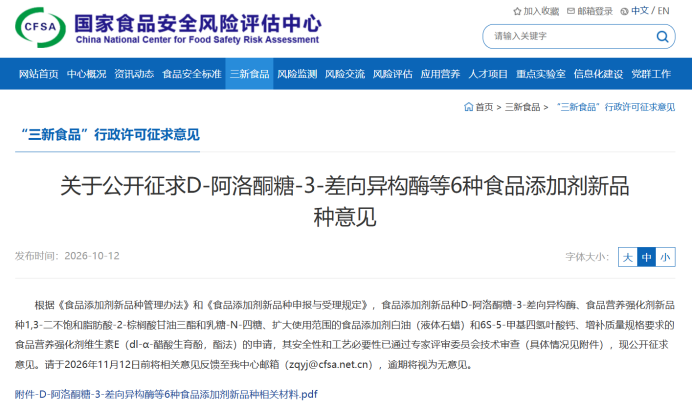
On October 12, 2026, China National Center for Food Safety Risk Assessment (CFSA) issued a public consultation on 6 new varieties of food additives. The consultation is open until November 12, 2026, and comments or suggestions can be submitted to the official email address: xspyl@cfsa.net.cn. Details are as follows:
D-psicose-3-epimerase has previously been approved as an enzyme preparation for use in the food industry under the National Health Commission (NHC) Announcement No. 3 of 2023 and subsequent announcements.
The D-psicose-3-epimerase currently under public consultation is a new enzyme preparation derived from a different production microorganism. It is primarily used to catalyze the conversion of D-fructose into D-psicose.
2.1,3-diunsaturated fatty acyl-2-palmitoyl glycerol (UPU) has been proposed as a new food nutrition fortifier for use in formulated milk powder (limited to milk powder for children) (food category 01.03.02), infant formula (food category 13.01.01), follow-up formula for older infants and young children (food category 13.01.02), and infant formula for special medical purposes (food category 13.01.03).
Based on the safety assessment, the substance is considered safe for use in the proposed food categories. Its quality specifications shall comply with the relevant requirements outlined in the draft released for public consultation.
Lacto-N-tetraose (LNT) has been proposed as a new food nutrition fortifier for use in formulated milk powder (limited to milk powder for children) (food category 01.03.02), infant formula (food category 13.01.01), follow-up formula for older infants and young children (food category 13.01.02), and infant formula for special medical purposes (food category 13.01.03).
LNT is a human milk oligosaccharide (HMO) naturally present in breast milk and is used as a food nutrition fortifier. Based on the safety assessment, LNT is considered safe for use in the proposed food categories. Its quality specifications shall comply with the relevant requirements outlined in the draft released for public consultation.
White mineral oil is already listed as a food processing aid under China's National Food Safety Standard - Standard for Uses of Food Additives (GB 2760). It is currently permitted for use as an antifoaming agent, release agent, anti-sticking agent, and lubricant in the processing of potato products, confectionery, collagen casings, soy products, fresh yeast products, and other foods.
The current application seeks to expand its scope of use to include its use as a coolant in the production of microbial culture preparations for food processing.
Based on the safety assessment, white mineral oil is considered safe for use in this application. Its quality specifications shall comply with the National Food Safety Standard - Food Additive: White Mineral Oil (also Known as Liquid Paraffin) (GB 1886.215).
Folic acid is already listed as a food nutrition fortifier under China's National Food Safety Standard - Standard for the Use of Nutritional Fortification Substances in Foods (GB 14880), with permitted uses in formulated milk powder, rice (limited to rice that does not require washing), wheat flour, and other food categories.
Under Announcement No. 13 of 2017 issued by the former National Health and Family Planning Commission and subsequent announcements, 6S-5-methyltetrahydrofolate calcium was approved as a new food nutrition fortifier and a source of folic acid for use in formulated milk powder, solid beverages, foods for special medical purposes (excluding products covered under category 13.01), and other food categories.
The current application seeks to expand its scope of use to rice (limited to rice that does not require washing) (food category 06.02.01) to increase the folic acid content of fortified foods.
Vitamin E is already listed as a food nutrition fortifier under China's National Food Safety Standard - Standard for the Use of Nutritional Fortification Substances in Foods (GB 14880), with permitted uses in modified milk, formulated milk powder, beverages, soy milk, jelly, and other food categories. dl-α-Tocopheryl acetate is one of the permitted chemical sources of vitamin E.
The vitamin E currently under public consultation is produced using new starting materials, namely 2,3,5-trimethylhydroquinone diacetate and isophytol.
It is intended for use in the following food categories to increase the vitamin E content of fortified foods:
- Formulated milk powder (food category 01.03.02)
- Vegetable oils (food category 02.01.01.01)
- Margarine and similar products (food category 02.02.01.02)
- Soybean flour and soybean milk powder (food category 04.04.01.07)
- Soy milk (food category 04.04.01.08)
- Chewing gum-based confectionery (food category 05.02.01)
- Ready-to-eat cereals, including rolled oats (food category 06.06)
- Other foods for special dietary uses, excluding categories 13.01–13.04 (limited to sports nutrition foods) (food category 13.05)
- Beverages, excluding products covered under category 14.01 (food category 14.0)
- Jelly (food category 16.01)
Official Link: