导航菜单

The global cosmetics regulatory environment continues to evolve. To help businesses stay updated with regulatory changes, ZMUni Compliance Center regularly releases a monthly recap of global cosmetics regulations. This article covers the regulatory developments related to cosmetics in China and globally in June 2026, with an emphasis on updates in cosmetic ingredients and cosmetic management, among other areas.
In June 2026, 23 new cosmetic ingredients were notified with the China National Medical Products Administration (NMPA). They include:
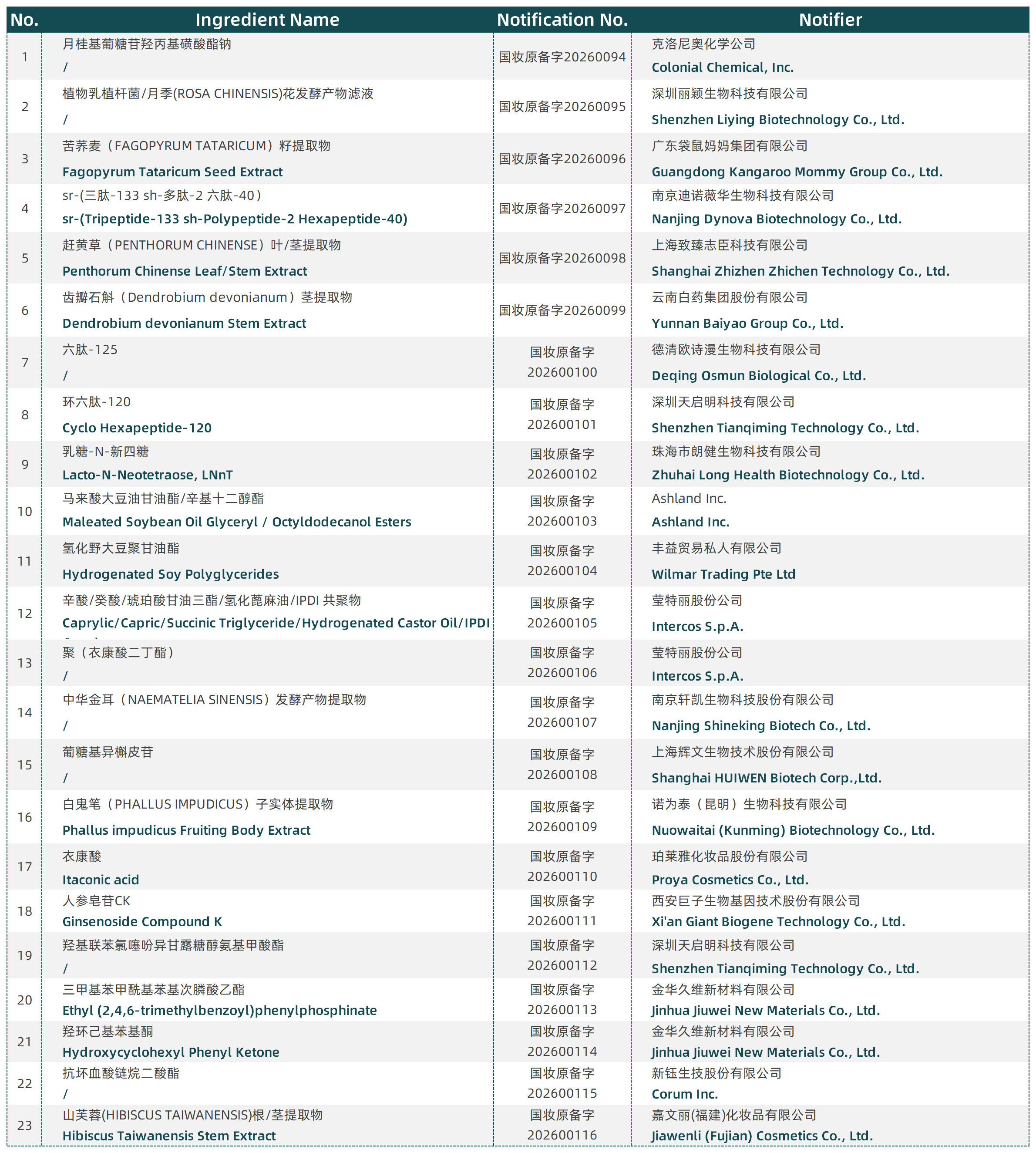
The technical requirements for the 23 NCIs mentioned above have not been disclosed, and they have not yet entered the safety monitoring period.
More Insights:
China's NCI Issue 47: Six Notified, Two Photoinitiators Included
China's NCI Issue 45: Peptides, Botanicals & Functional Molecules
......
🔘 China Opens Consultation on Draft Toothpaste Ingredient Standard
On June 4, 2026, China's National Medical Products Administration(NMPA) released a consultation draft of the mandatory national standard General Requirements on Raw Materials of Toothpastes for public comments. The consultation period runs from June 4 to August 4, 2026. This marks the first major revision in 18 years since the current standard (GB 22115-2008) was issued.
The draft proposes to specify 1,630 prohibited substances, 120 prohibited botanical and animal-derived substances, 58 restricted ingredients, 42 permitted preservatives, and 103 permitted colorants.
Source: https://www.nmpa.gov.cn/xxgk/zhqyj/zhqyjhzhp/20260604172855175.html
🔘 China Releases Two Draft National Standards on Cosmetic Adverse Reactions, Covering Cheilitis and Contact Urticaria
On June 15, 2026, China NMPA released two draft mandatory national standards for public consultation: Evaluation Criteria and Management Principles for Cosmetic Cheilitis and Evaluation Criteria and Management Principles for Cosmetic Contact Urticaria. The consultation period runs from June 15 to August 15, 2026. See previous news.
🔘 China Rejects 26 Batches of Non-Compliant Cosmetics in May 2026
On June 22, 2026, China's General Administration of Customs (GACC) released information on imported cosmetics denied entry in May 2026. A total of 26 batches of non-compliant cosmetic products were rejected. Labeling non-compliance was the most prominent issue, accounting for 21 batches. In addition, two batches were rejected due to packaging non-compliance, two batches due to arsenic test failures, and one batch due to excessive total microbial count.
Source: http://jckspj.customs.gov.cn/spj/2026-06/22/article_2026062211314769471.html
🔘 China Introduces Two New Rules on New Cosmetic Ingredients, Further Optimizing Regulatory Requirements
On June 26, China NMPA issued the Provisions for Management of New Cosmetic Ingredient Registration and Notification Dossiers (hereinafter the "New Provisions"), effective July 15, replacing the 2021 version. The new rules consist of 15 articles and aim to clarify regulatory boundaries, streamline administrative requirements, and encourage innovation by reducing compliance burdens for new cosmetic ingredient development.
On the same day, in support of the New Provisions, China's National Institutes for Food and Drug Control (NIFDC) also released the Technical Guidelines for Dossier Requirements on the Registration and Notification of New Cosmetic Ingredients. See previous news.
🔘 China Proposes Standardization of Ethyl Butylacetylaminopropionate for Cosmetics
On June 26, 2026, China NMPA issued a public notice on proposed cosmetic standard-setting projects. The proposed standard concerns Ethyl Butylacetylaminopropionate, a mosquito-repellent active ingredient also used in pesticides. The ingredient is included in the Inventory of Existing Cosmetic Ingredients in China (IECIC Part I), allowing its compliant use in personal care and daily chemical products.
Source: https://www.nmpa.gov.cn/hzhp/hzhpjgdt/20260626104507124.html
🔘 China Proposes New Framework to Strengthen Cosmetic Standardization System
On June 30, 2026, China NMPA released a comprehensive consultation draft titled Administrative Measures for Cosmetic Standards (Draft For Comments). The draft aims to strengthen and standardize the regulatory framework governing cosmetics—including toothpaste—to ensure product safety and support high-quality industry development. Stakeholders may submit comments until July 30, 2026. See previous news.
🔘 Indonesia Proposes Draft Guidelines for Halal Assurance System Implementation in Cosmetics
On June 3, 2026, the Halal Product Assurance Organizing Agency of Indonesia (BPJPH) submitted a Technical Barriers to Trade (TBT) notification (G/TBT/N/IDN/187) to the World Trade Organization (WTO), proposing the draft Guidelines for the Implementation of the Halal Assurance System (HAS) for Cosmetics. Based on Indonesia's Halal Product Assurance Law and Government Regulation No. 42 of 2024, these guidelines aim to establish a unified framework for implementing the Halal Assurance System across the cosmetics industry, covering businesses, halal supervisors, auditing agencies, and relevant stakeholders. The regulation defines the specific HAS standards applicable to cosmetic products and identifies critical halal control points throughout the production process to ensure the continuity of halal compliance. The final date for stakeholders to submit comments on this notification is August 2, 2026.
Source: G/TBT/N/IDN/187
🔘 Thai FDA Consults on Six Draft Revisions Over Cosmetic Ingredients
On June 9, 2026, the Thai Food and Drug Administration (Thai FDA) launched a public consultation on six draft notifications concerning cosmetic ingredients to further align its regulatory framework with the ASEAN Cosmetic Directive (ACD). Key proposals include:
Adding 10 new prohibited substances (including Quaternium-15, Benzophenone, etc.);
Adding 3 new restricted substances (Acid Yellow 3, BHT, and Verbena absolute related components);
Revising technical specifications and labeling warnings for existing ingredients, including Salicylic Acid, Zinc Pyrithione, and certain permitted UV filters (Homosalate and Benzophenone-3).
The public consultation remains open until July 8, 2026 (with certain feedback portals closing on July 7, 2026).
Source: https://www.law.go.th/listeningDetail?survey_id=NzMzMkRHQV9MQVdfRlJPTlRFTkQ=
🔘 South Korea Releases Non-Binding Guidelines for Preparing Cosmetic Safety Assessment Data
On June 10, 2026, South Korea's Ministry of Food and Drug Safety (MFDS) officially released the Guidelines for Preparing Cosmetic Safety Assessment Data (Guideline-1506-01). This guidance document aims to help domestic and foreign cosmetic manufacturers, distributors, exporters, and safety assessment institutions accurately compile safety evaluation dossiers for raw materials and finished products, clarifying data acceptance criteria and report structures to streamline the official technical review process.
Source: MFDS - Guidelines for Preparing Cosmetic Safety Assessment Data (Guideline-1506-01)
🔘 Indonesia BPOM Opens Consultation on Draft Regulation on Product Recall and Destruction
On June 10, 2026, Indonesia's National Agency of Drug and Food Control (BPOM) released Draft Regulation No. 1754 on the recall and/or destruction of natural medicines, quasi medicines, health supplements, and cosmetics for public consultation, with a comment deadline of June 30, 2026.
The proposed regulation introduces a risk-based framework intended to streamline recall and destruction procedures across regulated product categories. It also formalizes specific triggering conditions for enforcement actions, including non-compliant advertising and failures in Product Information File (PIF) audit requirements.
Once adopted, the new regulation is expected to replace BPOM Regulation No. 11 of 2017, which currently governs cosmetic recall procedures, thereby consolidating and updating Indonesia’s regulatory framework for post-market control.
Source: Draft Regulation No. 1754
🔘 Australia TGA Launches Consultation on GMP Inspection Transparency
On June 10, 2026, Australia's Therapeutic Goods Administration (TGA) initiated a public consultation on improving the transparency of Good Manufacturing Practice (GMP) inspection outcomes.
The consultation seeks views on how GMP compliance information should be displayed on the TGA website, including the presentation and accessibility of GMP certificates and inspection results, the clarity and accuracy of published information, and the balance between transparency and protection of confidential data, as well as the potential impacts and benefits of publication.
The consultation closes on July 13, 2026.
🔘 South Korea Expands Crackdown on Counterfeit Cosmetics from Overseas Direct Purchases
On June 19, 2026, Korea's Ministry of Intellectual Property (MOIP) announced a joint initiative with MFDS and Korea Customs Service (KCS) to strengthen inspections of cosmetics purchased via overseas online platforms, targeting counterfeit risks and protecting K-beauty IP rights.
The annual inspection volume will increase from 1,080 cases to 1,200 cases in 2026, focusing on suspected counterfeit products. The program covers four stages: information gathering, purchasing, testing, and follow-up actions. Enforcement measures may include customs suspension and online sales blocking, with results disclosed via the MFDS website.
🔘 South Korea Announces Full Revision of the Korean Pharmacopoeia
On June 29, 2026, South Korea's MFDS issued a notification of the complete revision of the Korean Pharmacopoeia (Notice No. 2026-44). Pursuant to Paragraph 1, Article 51 of the Pharmaceutical Affairs Act, this notice comprehensively updates and structurally reorganizes the entirety of the pharmacopoeia, including General Notices, General Rules for Preparations, Monographs (Part 1 and Part 2), General Tests, and General Information. The revised pharmacopoeia will enter into force 3 months after its announcement.
Source: MFDS - Notice No. 2026-44
🔘 EU Publishes Roadmap to Phase Out Animal Testing in Chemical Safety Assessments
On June 1, 2026, the European Commission (EC) published the Roadmap towards phasing out animal testing for chemical safety assessments (C(2026)3497), accompanied by a staff working document (SWD(2026)144).
The roadmap responds to the European Citizens' Initiative "Save Cruelty-Free Cosmetics" and aims to support a transition towards non-animal methods in chemical safety assessments.
It outlines three key directions: accelerating the uptake of non-animal methods across chemicals, cosmetics, pesticides, and pharmaceuticals; promoting the use of advanced technologies such as artificial intelligence in safety assessment; and strengthening cooperation within the EU and with international partners to support methodological convergence.
🔘 US FDA Warns Consumers Against OTC Skin Lightening Products Containing Mercury and/or Hydroquinone
On June 1, 2026, the U.S. Food and Drug Administration (FDA) issued a public safety alert advising consumers not to use over-the-counter (OTC) skin lightening products containing hazardous levels of mercury and/or hydroquinone, emphasizing that no such products are currently approved or legally marketed in the U.S.
The FDA noted that illegally marketed mercury-containing products can be absorbed through the skin, and long-term exposure may lead to serious health effects, including kidney damage, neurological impairment, and skin injuries. Products illegally formulated with hydroquinone have been associated with rashes, facial swelling, and permanent pigmentation disorders such as exogenous ochronosis.
Except for very limited exemptions, mercury is prohibited in cosmetics, and over-the-counter hydroquinone products have not been approved for safety or efficacy. The FDA is stepping up enforcement against such health fraud products, including product seizures and import bans.
🔘 US FDA Expands Sunscreen Options for the First Time in 20 Years, Adding "Bemotrizinol" to OTC Monograph
On June 9, 2026, the US FDA issued an official press announcement formally adding the new active ingredient Bemotrizinol to the over-the-counter (OTC) sunscreen monograph at concentrations up to 6%. Marking the first time in over 20 years that the FDA has expanded its permitted sunscreen list since the late 1990s, bemotrizinol is also the first new ingredient cleared under the streamlined administrative order process established by the CARES Act. Formally designated as Generally Recognized as Safe and Effective (GRASE) for adults and children aged 6 months and older, this broad-spectrum filter features low systemic skin absorption. The final order takes effect on August 9, 2026, allowing compliant formulations to bypass the NDA process, while granting initial petitioner DSM 18 months of marketing exclusivity.
Source:
🔘 Brazil Updates Prohibited and Restricted Cosmetic Ingredient Lists Following Mercosur Revisions
On June 11, 2026, the Brazilian Health Regulatory Agency (Anvisa) published Resolution RDC No. 1029/2026 and Resolution RDC No. 1030/2026, updating the restricted and prohibited ingredient lists for cosmetic products. These mandatory regulations incorporate the latest Mercosur resolutions into the national regulatory framework and took effect immediately upon publication. Key updates include:
Resolution RDC No. 1029/2026 (Restricted List): Incorporates Mercosur/GMC/Resolution No. 06/2025, replacing the former RDC No. 530/2021 to update substance use conditions based on recent scientific evidence and introduce standardized INCI names and CAS numbers for 194 listed entries;
Resolution RDC No. 1030/2026 (Prohibited List): Incorporates Mercosur/GMC/Resolution No. 07/2025 to update the annex of RDC No. 529/2021, introducing 13 new prohibited entries, revising 4 existing entries, and removing 4 entries.
Sources:
Note: This article is compiled by ZMUni Compliance Centre, drawing from the latest updates from official regulatory authorities in various countries and regions. For any questions regarding interpretations or expressions, please consult the official real-time announcements.
Official Link: