导航菜单

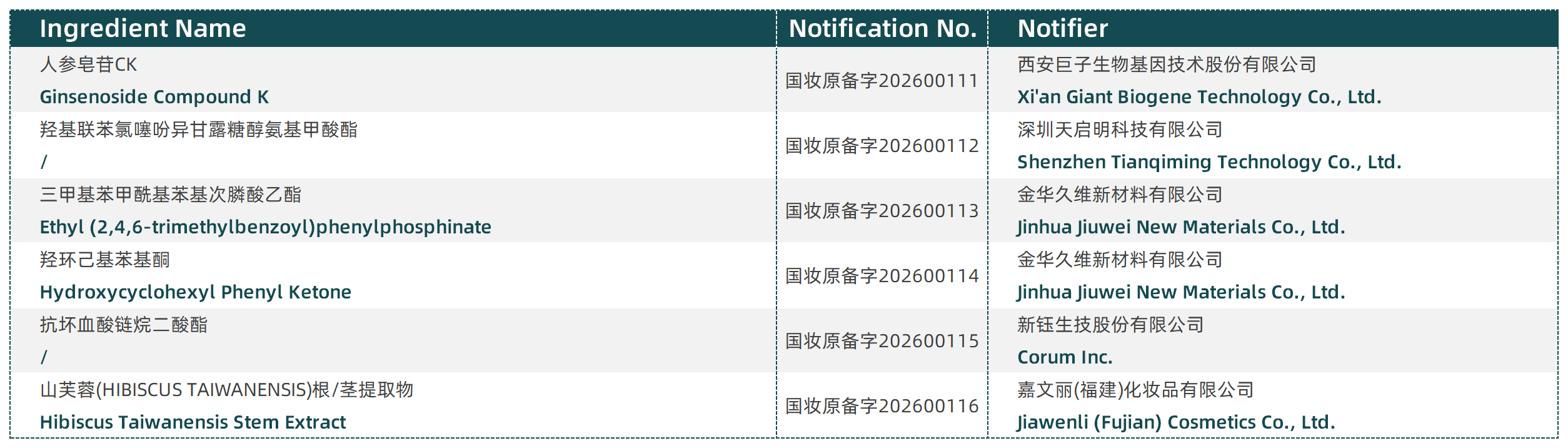
During the last week of June 2026, a total of six new cosmetic ingredients completed notification with China's National Medical Products Administration (NMPA). The technical requirements for all related NCIs have not been publicly disclosed.
According to the notifier Giant Biogene, this Ginsenoside Compound K adopts a differentiated production pathway, integrating an enzyme-directed biotransformation process with high-purity preparative separation technology for rare ginsenosides.
The notified ingredient is positioned for skin barrier repair and sebum regulation, addressing key concerns in oily and acne-prone skin.
Photoinitiators are functional chemical agents widely used in UV/LED-curable systems, enabling rapid polymerization in coatings, inks, 3D printing materials, electronics, dental resins, and cosmetic nail products, including UV-curable gel nail polish, nail extension gels, builder gels, top coats, and other light-cured nail formulations used in manicure and pedicure applications.
These two ingredients were notified by the same Chinese company, which is engaged in the manufacturing of chemical raw materials and chemical products.
Hibiscus taiwanensis, or the Taiwan cotton rose, is a species of flowering plant in the family Malvaceae. It is a tree or shrub endemic to the Alishan Range of Taiwan. According to literature, its flowers are edible, and its roots and stems have been used in traditional medicine, with functions such as clearing lung heat, cooling the blood, detoxification, reducing swelling and pus formation, and relieving inflammation and pain.
In October 2022, the notifier first filed this NCI, and the notification was subsequently voluntarily withdrawn in October 2024; it was re-notified again in June this year.