导航菜单

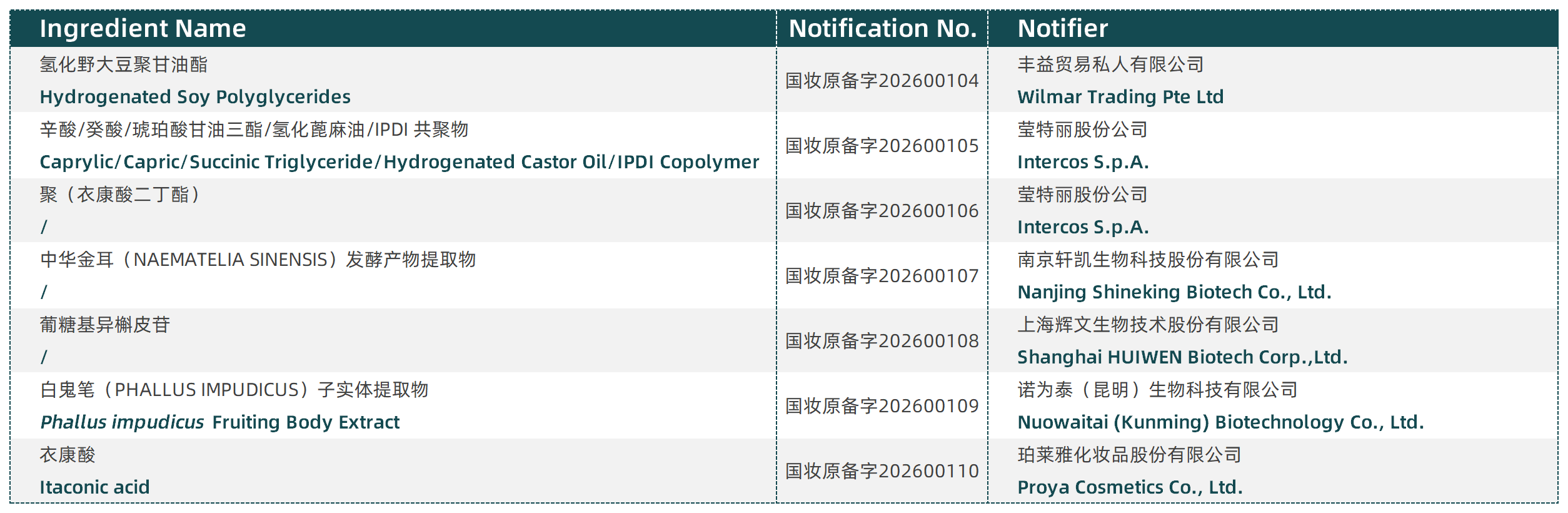
From June 15 to June 23, 2026, 7 new cosmetic ingredients (NCIs) have completed notifications with China's National Medical Products Administration (NMPA). The technical requirements have not been disclosed yet.
Hydrogenated Soy Polyglycerides is the product obtained through catalytic metathesis of Glycine Soja (Soybean) Oil, followed by hydrogenation. According to PCPC, its functions include Skin-Conditioning Agent (Occlusive) and Viscosity Increasing Agent (Nonaqueous). This notification marks the first NCI submission from a Singapore-based company under China's NCI framework.
In this issue, Intercos S.p.A. notified two NCIs, both classified as polymers. It is worth noting that Intercos previously notified Caprylic/Capric/Succinic Triglyceride/Hydrogenated Castor Oil/IPDI Copolymer (Notification No. 20260049) in March this year, suggesting that the current submissions (Notification No. 20260105 and 20260106) may be related to updates or modifications of existing information.
With these two notifications, Intercos has now submitted a total of 11 NCIs, making it the leading overseas company in terms of NCI notifications in China to date.
This ingredient is a fermentation-derived active substance based on Naematelia sinensis.
Naematelia sinensis is a gelatinous fungus native to China, commonly known as "Jin'er mushroom", with economic and medicinal relevance. It is an obligate parasitic species requiring Stereum hirsutum or related fungi for fruiting body formation. Naematelia aurantialba, another species within the same genus (Naematelia), shares similar morphology and is often grouped under the same common name (Jin'er mushroom) due to their close resemblance.
This marks the first NCI notification involving N. sinensis. In comparison, Naematelia aurantialba fruiting body extract is one of the most frequently notified NCIs, with eight notifications to date.
Phallus impudicus, known colloquially as the common stinkhorn, is a widespread species of fungus in the Phallaceae (stinkhorn) family. It is recognizable for its foul odor and its phallic shape when mature, the latter feature giving rise to several names in 17th-century England. Despite its foul smell, it is not usually poisonous and immature mushrooms are consumed cooked on their own or feature as an ingredient in cuisines of parts of the Czech Republic, France and Germany.
The notifier, Nuowaitai (Kunming) Biotechnology Co., Ltd., has already notified six NCIs this year. The company focuses on biotechnology innovation and is affiliated with Botanee Group, a leading player in the cosmetics industry in China.
In May 2025, the notifier Shanghai HUIWEN Biotech Corp., Ltd. filed a patent (CN120053310A) titled "Application of glucosyl modified quercetin derivative and composition containing same". The invention discloses the use of glucosyl-modified quercetin derivatives as anti-photoaging agents, with glucosyl-modified isoquercitrin showing notable effects in improving skin hydration loss, elasticity, and roughness, supporting its anti-aging potential in cosmetic applications.
Itaconic acid is a highly reactive, easily polymerizable compound widely used in the chemical industry. In recent years, it has gained increasing attention in cosmetics due to its unique properties and application potential.
In May 2025, PROYA Group's Shanghai branch published a patent (CN119606771A) on its use in hair repair products. The invention describes compositions containing itaconic acid and pH regulators (e.g., sodium hydroxide or arginine), demonstrating potential benefits in hair fiber repair and strengthening.