导航菜单

The global cosmetics regulatory environment continues to evolve. To help businesses stay updated with regulatory changes, ZMUni Compliance Center regularly releases a monthly recap of global cosmetics regulations. This article covers the regulatory developments related to cosmetics in China and globally in September 2026, with an emphasis on updates in cosmetic ingredients and cosmetic management, among other areas.
In September 2026, 12 new cosmetic ingredients were notified with the China National Medical Products Administration (NMPA). They include:
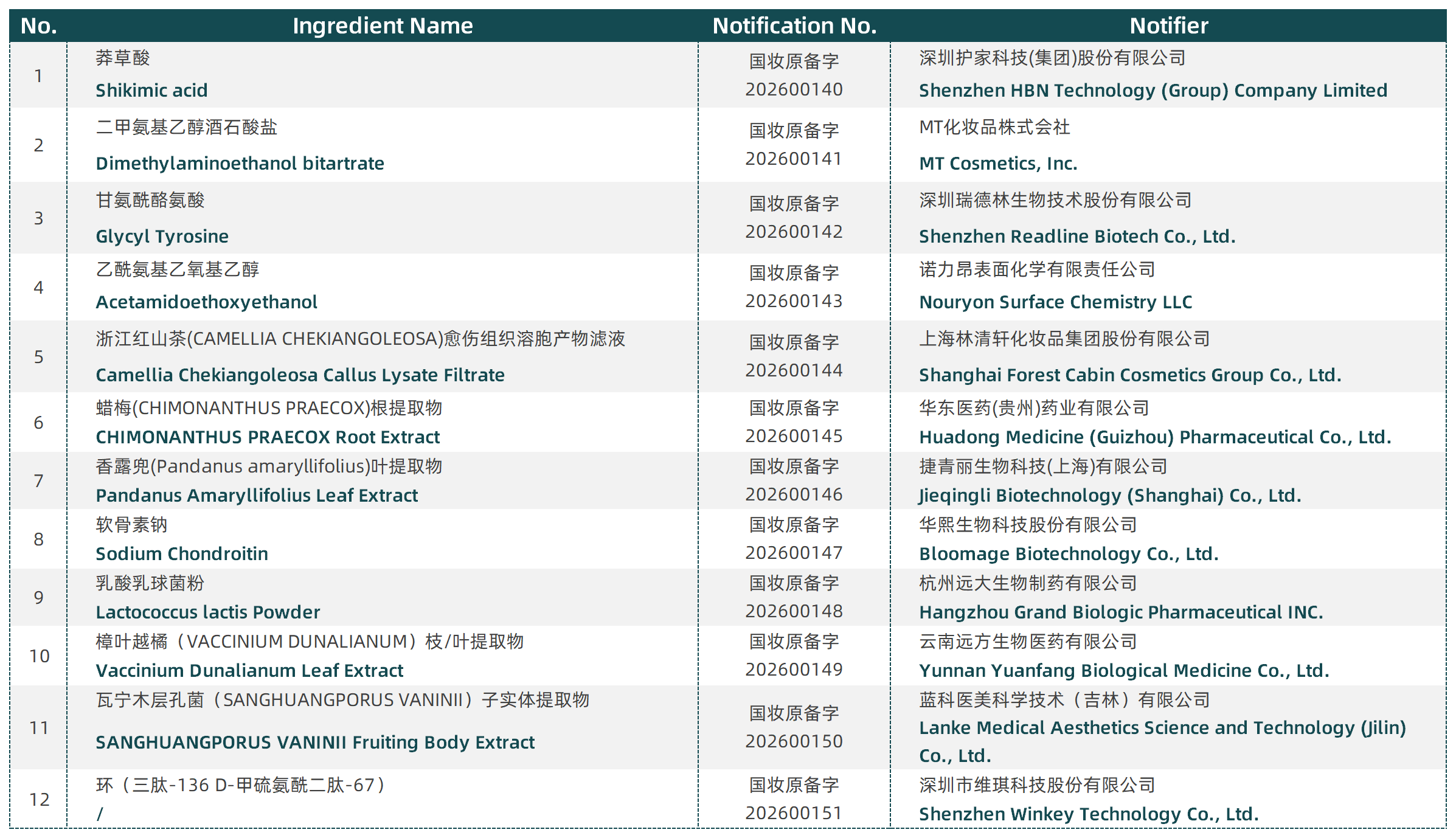
The technical requirements for the 12 NCIs mentioned above have not been disclosed, and they have not yet entered the safety monitoring period.
More Insights:
China's NCI Issue 53: 5 New Bioactive Ingredients from Diverse Sources
China's NCI Issue 52: 7 New Cosmetic Ingredients Notified in Early September
🔘 China's Cosmetic E-Label Pilot Program: Hainan Extension and 14 New Zhejiang Participants
On September 1, 2026, regulatory authorities in Hainan and Zhejiang announced new developments in China's cosmetic e-label pilot program.
In Hainan, the pilot period for e-labels on cosmetics sold under the island's duty-free program has been extended to January 31, 2029, in line with the pilot period specified in the NMPA's Notice on Launching the Pilot Program for Cosmetic E-Labels (NMPA [2025] No. 16). Companies participating solely in the Hainan duty-free cosmetic e-label pilot and assigning QR codes themselves or through third parties must ensure that their coding systems and e-label QR codes comply with the relevant requirements and submit pilot product information to the Hainan Medical Products Administration.
In Zhejiang, the provincial Medical Products Administration announced the second batch of 14 companies selected for the cosmetic e-label pilot. The initiative aims to improve cosmetic and toothpaste label management, enhance consumer access to product information, address the needs of older consumers, and facilitate business operations.
Source: Hainan Medical Products Administration and Zhejiang Medical Products Administration
🔘 China's New National Standard for Facial Cleansers Takes Effect
Effective September 1, 2026, China's recommended national standard GB/T 29680-2026, Facial Cleansers (Cream, Liquid, Mousse, Gel and Powder), jointly issued by the State Administration for Market Regulation (SAMR) and the Standardization Administration of China (SAC), officially came into force.
The new standard replaces GB/T 29680-2013, Facial Cleansers and Cleansing Creams, which had been in effect for more than a decade. It expands the scope from traditional facial cleansers and cleansing creams to cream, liquid, mousse, gel and powder formulations, providing broader coverage of facial cleanser products currently on the market.
🔘 China Rejects 25 Non-compliant Imported Cosmetics in August
On September 20, 2026, China's General Administration of Customs (GACC) released information on imported cosmetics denied entry in August 2026. A total of 25 batches of non-compliant cosmetic products were denied entry. Among them, 1 batch failed to provide the required certificates or conformity documents, 3 batches had discrepancies between the goods and the accompanying documents, 18 batches had non-compliant labeling, 2 batches had a shelf life that did not meet national standards, and 1 batch had non-compliant packaging.
Source: China Customs
🔘 China Opens Public Consultation on 2027 Cosmetic Standards Development Plan
On September 23, 2026, China's National Institutes for Drug Control (NIDC) announced a public call for proposals for the development and revision of the 2027 Cosmetic Standards Plan. Organizations and individuals may submit proposals through the Cosmetic Standards Development and Revision Management System on the NIDC website by November 22, 2026. See previous news.
🔘 China NIDC Seeks Comments on Information for 913 Existing Cosmetic Ingredients
On September 24, 2026, China NIDC issued a notice seeking public comments on information related to 913 existing cosmetic ingredients, including supplementary information such as CAS numbers, structural formulas, molecular formulas, and molecular weights for certain ingredients. See previous news.
🔘 South Korea Strengthens the Legal Framework for the Cosmetics Industry
On September 15, 2026, South Korea enacted the Act on the Promotion and Support of the Cosmetics Industry and amended the Cosmetics Act. Both laws will take effect on September 16, 2027.
The newly enacted Act establishes a systematic framework for promoting and supporting the cosmetics industry, including five-year development plans, an innovative cosmetics company certification scheme, support for R&D and professional training, and the establishment of a comprehensive industry support center and integrated information system. The amended Cosmetics Act strengthens the regulatory governance framework by establishing a Cosmetics Management Council under the Ministry of Food and Drug Safety (MFDS) and requiring the development of a five-year basic cosmetics management plan and annual implementation plans covering cosmetics safety management, regulatory support, and international cooperation.
Source:
1. Cosmetics Act (Act No. 21950)
2. Act on the Promotion and Support of the Cosmetics Industry (Act No. 21939)
🔘 South Korea and Indonesia Strengthen Halal Certification Cooperation to Support K-Beauty Exports
On September 18, 2026, Korea's Ministry of Food and Drug Safety (MFDS) announced strengthened cooperation with Indonesia on halal certification to support the export of Korean food and cosmetic products to the Indonesian market. The cooperation will include information exchange and support related to halal certification requirements.
The initiative is expected to support Korean companies seeking to expand into Indonesia, including K-Beauty exporters. Relevant businesses should monitor further developments on halal certification cooperation and market access requirements.
Source: South Korea MFDS
🔘 Australia Proposes Tighter Requirements for Vitamin A and Acetophenone in Cosmetics
On September 11, 2026, Australia's Therapeutic Goods Administration (TGA) opened a consultation on proposed amendments to the Poisons Standard, including measures directly relevant to Vitamin A and acetophenone in cosmetics and personal care products. The proposal would express permitted Vitamin A concentrations in retinol equivalents (RE) and lower the permitted concentrations for certain topical products. It also proposes an exemption threshold of 0.2% or less for acetophenone in cosmetic and domestic products.
The proposals will be considered by the Advisory Committee on Chemicals Scheduling (ACCS) at its November 2026 meeting. The deadline for public comments is October 12, 2026. Cosmetic and personal care businesses should monitor the proposed concentration limits and subsequent regulatory developments.
Source: Australia TGA
🔘 Australia Proposes Tighter Controls on 4-MBC in Cosmetics and Sunscreens
On September 11, 2026, Australia's TGA opened a public consultation on proposed controls for 4-methylbenzylidene camphor (4-MBC), a UV filter used in some sunscreen products. 4-MBC is not currently listed in Australia's Poisons Standard. Three regulatory options have been proposed:
Option 1: Set a uniform exemption threshold of 0.39% for 4-MBC in cosmetics and therapeutic sunscreens;
Option 2: Apply different concentration limits depending on the product type, application site and age group. The proposed limits include 0.95% for therapeutic sunscreens applied to the face and hands, 3.8% for certain products intended for people aged 18 and over, and 3.3% for cosmetics applied to the face and hands;
Option 3: List 4-MBC in Schedule 10, effectively prohibiting its use in all therapeutic goods and cosmetic products.
The proposals are still under consultation and no final decision has been made. They will be considered at the joint November 2026 meeting of the Advisory Committee on Medicines Scheduling (ACMS) and the Advisory Committee on Chemicals Scheduling (ACCS). The deadline for public comments is October 12, 2026.
Source: Australia TGA
🔘 New Zealand Restricts Three POPs, Including PFAS Used in Personal Care Products
On September 23, 2026, New Zealand's Environmental Protection Authority (EPA) announced that the Government has approved amendments to the Hazardous Substances and New Organisms Act to restrict chlorpyrifos, medium-chain chlorinated paraffins (MCCPs), and long-chain perfluorocarboxylic acids (LC-PFCAs). LC-PFCAs are a group of long-chain PFAS that have been used in various applications, including personal care products.
The restrictions on MCCPs and LC-PFCAs will take effect on December 16, 2026, while restrictions on chlorpyrifos will take effect on July 8, 2027. Certain essential-use exemptions apply to MCCPs and LC-PFCAs. Personal care businesses should monitor the restrictions and assess the use of PFAS-related ingredients in their products and supply chains.
Source: New Zealand EPA
🔘 Vietnam Issues Consolidated Guidance on ASEAN Cosmetic GMP
On September 10, 2026, Vietnam's Ministry of Health issued Consolidated Document No. 18/VBHN-BYT, consolidating and updating existing provisions on the implementation and guidance of the ASEAN Cosmetic Good Manufacturing Practice (ASEAN Cosmetic GMP) principles and standards. The document provides the applicable framework for cosmetic manufacturers implementing ASEAN Cosmetic GMP requirements in Vietnam.
The document covers cosmetic manufacturing quality management and GMP implementation requirements. Relevant businesses should monitor the applicable GMP compliance requirements for cosmetic manufacturing facilities in Vietnam. The document is a consolidated version of existing regulations rather than a newly introduced standalone GMP regulation.
Source: Ministry of Health of Vietnam
🔘 Vietnam Joins the Apostille Convention, with Decree No. 293/2026/ND-CP Taking Effect
On September 11, 2026, Vietnam officially became a party to the Hague Convention of October 5, 1961 Abolishing the Requirement of Legalisation for Foreign Public Documents (Apostille Convention). On the same date, Decree No. 293/2026/ND-CP entered into force, establishing the implementation framework for Apostille certification.
Under the new framework, foreign public documents issued in countries where the Apostille Convention applies with Vietnam and bearing a valid Apostille certificate can generally be used in Vietnam without further consular legalisation. For countries or documents outside the scope of the Convention, the existing consular certification or legalisation procedures remain applicable.
Source: Vietnam Government Information and Communications Agency
🔘 Indonesia Confirms Mandatory Halal Certification Implementation from October 18, 2026
On September 15, 2026, Indonesia's Halal Product Assurance Organizing Agency (BPJPH) reaffirmed that mandatory halal certification will be implemented as scheduled from October 18, 2026. Relevant government authorities are coordinating to ensure implementation readiness, with particular attention to the halal compliance of imported products and raw materials.
BPJPH has previously confirmed that the mandatory halal certification requirements effective from October 18 will cover cosmetics, pharmaceuticals, food and beverages, and various consumer products. Cosmetic businesses exporting to Indonesia should prepare for the applicable halal certification and foreign halal certificate registration requirements.
Source: BPJPH
🔘 Indonesia Proposes Strengthened Halal Requirements for Processing Services
On September 24, 2026, Indonesia notified the WTO under G/TBT/N/IDN/197 a draft guideline for the implementation of the Halal Product Assurance System (SJPH) for processing services. The guideline covers contract manufacturing, shared kitchens, water treatment, and grinding/milling services related to food, beverages, drugs, and cosmetics, with requirements covering halal raw materials, process segregation, packaging and labeling, and traceability.
The deadline for comments is November 23, 2026. The draft is proposed to take effect after the phased transition period for mandatory halal certification of processing services ends. Relevant businesses should monitor the final requirements and implementation timeline.
Source: G/TBT/N/IDN/197
🔘 U.S. FDA Clarifies It Does Not Issue Compliance Certificates for Cosmetics
On September 9, 2026, the U.S. FDA clarified that it does not issue certificates, verification letters, or other documents to confirm compliance with cosmetic facility registration or product listing requirements. Under MoCRA, applicable cosmetic facilities must register with the FDA and renew their registration every two years, while responsible persons must list marketed cosmetic products and update the listings annually. However, a registration or product listing number does not indicate FDA approval of the facility or product.
The FDA also noted that some e-commerce platforms may request proof of FDA registration or exemption, but the agency does not issue such documents. Businesses should therefore distinguish between FDA registration/product listing and FDA approval or certification.
Source: U.S. FDA
🔘 U.S. FDA Removes Two Active Ingredients from OTC Sunscreen Monograph
On September 10, 2026, the U.S. FDA issued a final administrative order removing aminobenzoic acid (PABA) and trolamine salicylate from the list of active ingredients permitted under the OTC sunscreen monograph (Monograph M020). FDA determined that the risks associated with their use in sunscreen drug products outweigh their benefits based on available safety data.
The decision affects sunscreen products marketed as OTC drugs in the U.S. FDA noted that it is not aware of any currently marketed U.S. sunscreen products containing these ingredients. The agency is continuing to review other sunscreen active ingredients and related regulatory requirements.
Source: U.S. FDA
Note: This article is compiled by ZMUni Compliance Centre, drawing from the latest updates from official regulatory authorities in various countries and regions. For any questions regarding interpretations or expressions, please consult the official real-time announcements.
Official Link: